Episode 12 on shibui
You can't tell on the shelf
What have you kept coming back to on nothing more than a hunch there was more there — and what did it finally give up that the sweet, obvious things never could?
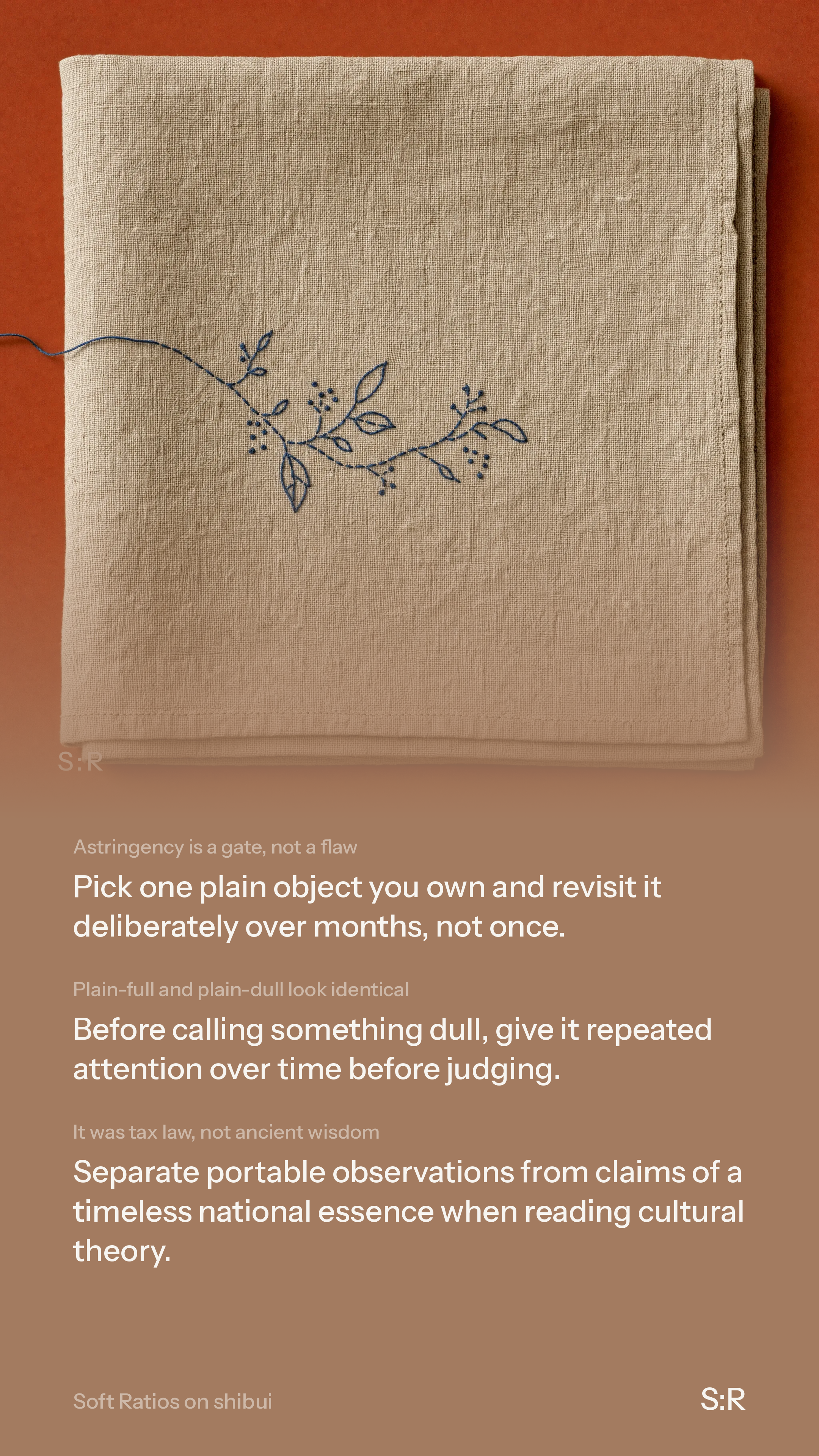 The three essentials, as a cardTap to enlarge — save it if it earns a place
Transcript
FigureThis is Soft Ratios Radio.
GroundThe voices are synthetic no act, just the thinking.
FigureHoyd Breton, a designer at Soft Ratios Studio, teaching himself in the open.
GroundOne subject at a time. Today, shibui.
GroundBite an unripe persimmon. Not a slightly green one — a properly unripe one. Your whole mouth goes dry and tight, like the inside of your cheeks are trying to leave. That pucker has a name in Japanese. Shibui.
FigureAnd the strange part is where that word ends up. It's the ordinary antonym of amai — sweet. Shibui: not sweet. Astringent. But a man named Yanagi Sōetsu, a potter, took that exact word and wrote that it's the final criterion for the highest form of beauty. The highest. Named after the taste that makes you flinch.
GroundThat's the thing I can't walk past. We name beauty after sweetness everywhere else — a sweet face, a sweet melody. Here the culture reaches for the opposite. The flavor a child spits out. And says: that. That's the top.
FigureSo it's a real puzzle, not a poem. How does a word for something unpleasant become the name for the deepest beauty there is — and what's it about that beauty the sweetness can't do?
GroundAnd I want to be careful, because the easy answer's right there and I don't trust it. Everyone reaches for the same shelf. Wabi-sabi. Japanese minimalism. The plain grey room. Shibui gets filed under all of it.
FigureIt gets filed there and it doesn't belong there. That's the first thing worth taking apart. Start with the mouth, because the taste isn't a metaphor that got borrowed later — it's the root, and it's still literally true. The pucker is chemistry. The unripe fruit is packed with condensed tannins, proanthocyanidins, sitting in special cells. When you bite it, those tannins grab the proteins in your saliva and pull them out of solution. The slickness that normally coats your mouth just coagulates. That dry, gripping feeling is your own spit being precipitated. It isn't a flavor, exactly. It's a texture happening to you.
GroundSo the sensation is the fruit doing something to you. Not sitting there to be tasted.
FigureWhich matters more than it sounds. And here's the second half — you don't get rid of the astringency by cooking the tannins away. You seal the fruit up, starve it of air, and it makes acetaldehyde, which locks the tannins into a form that won't dissolve. They're still there. They've just stopped grabbing you. The astringency doesn't leave. It goes quiet.
GroundThe tannin stays in the fruit. It's just no longer reaching out. And that's the whole idea in a fruit, before anyone says a word about art. Take those same tannins and put them to work. They ferment the juice — kakishibu, the persimmon liquid — and it's nearly all tannin. People have used it for seven hundred years. Dyeing cloth, waterproofing fishing nets, preserving wood and paper. But the color's the tell. Most natural dyes need heat. This one comes up in air and sunlight, and then it keeps deepening — the brown goes browner for years. So the thing that bites your mouth is also the thing that preserves the net, and the thing that grows richer with time. The bite and the depth are one substance. You don't get to keep one and lose the other.
FigureThat's why the taste attaches so naturally to age. Yanagi said it outright — when a palate matures it starts to prefer plain monochromes, quiet things. And he admitted, yes, some will call that the taste of old age, and in a sense it is. A child spits out the persimmon. An adult learns to want exactly the thing that isn't immediately pleasing.
GroundWhich could just be adults flattering themselves. Too young to get it is what every gatekeeper says.
FigureIt could be. Except the fruit isn't flattering anyone. The unripe persimmon genuinely binds your saliva; the ripe one genuinely is sweet and simple and gone in a second. The claim isn't acquire our refined taste. It's narrower — that the thing which gives itself away at once has less to give than the thing that makes you work for it. Whether that's true is exactly what we should test. Because the next layer isn't philosophy, it's money and law. Edo Japan, under the Tokugawa. The merchant class, the chōnin, is getting rich — but it sits below the samurai, and the shogunate keeps issuing bans on extravagance. By the 1680s a commoner family can't put an embroidered crest on its clothes; merchants are told not to wear ordinary silk, only the plainer pongee. And the palette gets squeezed toward cotton and hemp, toward brown and grey and indigo. So here's a whole wealthy class forbidden to show it — and what they do with that is the birth of the thing. Plain dark kimono on the outside, lined with expensive silk you only glimpse when the person moves. An austere street front hiding an elaborate garden. A tea bowl that looks like nothing and repays close inspection. Modest outside, luxurious inside. Not poverty — wealth deliberately muted. And then it curdles from a workaround into a value, which is the interesting move. You hear it in the color story — forty-eight browns, a hundred greys. Shijūhatcha hyakunezumi. The numbers aren't literal; they just mean an enormous number. Denied bright color, they developed an almost absurd connoisseurship of the narrow band they were allowed. Fifty ways of being brown. A hundred greys, each one named. The restriction produced more discrimination, not less.
GroundRestraint as a workaround, then. They weren't being spiritual about it. They were taxed and policed into it. And this is where I want to say it — it's just wabi-sabi with a merchant's bank account. Plain surface, humble materials, understatement made beautiful. Same family.
FigureAnd it isn't — and that bank account is precisely why. Wabi is poverty made beautiful. Actual, embraced poverty — the lonely hut, the discipline of having little. Sabi is age and weathering made beautiful — patina, the melancholy of things touched by time. Both carry mortality; wabi-sabi, in Leonard Koren's phrase, makes you contemplate your own death. The silk-lined kimono contemplates nothing of the kind. It's rich, it's urbane, a little sly. Understatement, yes — but not poverty, and not mourning.
GroundBut the objects don't stay in their lanes. The Raku bowl, the Bizen ware — every one of those gets discussed under wabi-sabi, not shibui. In the actual pottery the categories bleed.
FigureThey do bleed, and I won't pretend at a hard border — that would be false precision. The honest relation is lopsided. Plenty of wabi and sabi objects are also shibui; not every shibui thing is wabi or sabi. Shibui is the bigger category — the less rustic, less mournful one. The kimono proves it. You can be shibui while being expensive and calm and not remotely sad. You cannot be wabi that way.
GroundSo we keep circling the same spot. Why name the best beauty after the flinch — after the taste that isn't sweet, isn't easy, isn't given.
FigureYanagi's answer is the one that actually earns the puzzle. He called this beauty introversive — inner radiance, not display. And then the sentence worth the whole essay: it's not beauty the maker shows you. It's beauty made so that you draw it out for yourself. In his words, it makes an artist of the viewer.
GroundAnd that's exactly where I get suspicious. Makes an artist of the viewer. That's a beautiful sentence and it's also the perfect cover story. If the depth is whatever the viewer draws out, then there's no depth to check. I stare at a grey bowl long enough, I feel something deep, and I credit the bowl. How is that different from the emperor's new clothes? How do you tell a shibui object that's genuinely rich from a dull one I've talked myself into loving?
FigureThere's a word for the failure case. Jimi. Plain, sober, unobtrusive — and it can just be dull. Drab. Jimi is quiet and that's all it is. The claim about shibui is that it's quiet and inwardly full, and the test isn't your feeling — it's whether the object keeps giving. The indigo that deepens with every wash. The glaze that reveals more in the hand than to the eye. The material genuinely changes; there's a substrate under the reticence. Jimi has a flat surface and nothing behind it. Shibui has a plain surface and something behind it.
GroundBut I only find out which one it is by living with it. On the shelf they look identical.
FigureWhich is the point, not a flaw in the point. Shibui refuses the quick read on purpose. There's a companion word — kirei — pretty, clean, tidy. Kirei gives itself away at once and then it's spent. You've seen it; there's nothing more. The whole wager of shibui is that the surface should not exhaust the thing. So of course you can't tell on the shelf. If you could, it would be kirei.
GroundSo the astringency is a filter. It puts a cost at the door.
FigureSay more.
GroundThe bite keeps out the person who only wants the sweet thing. The child, the tourist, the quick glance. If a thing is sweet, everyone gets it instantly and equally, and it's used up just as fast. If a thing withholds — if it's astringent — then the only people who reach the depth are the ones who stayed. Who came back a second time, a tenth time. Who washed the indigo until it deepened. And that reframes the whole maturity business. It's not adults being snobs about children. It's that some richness is only available on the far side of time. You literally cannot have it on first contact — the way you can't taste the deep color in the persimmon dye on day one. You have to leave it in the sun for years. So the beauty that makes an artist of the viewer isn't flattery. It's a description of a transaction. The object holds back; you supply the attention; the depth appears in the space between, over time. Sweetness asks nothing of you, gives you everything at once, and then it's over. Astringency asks for your return and pays out slowly. That's why it sits at the top. It's the only beauty that keeps.
FigureThen the astringency isn't the obstacle to the beauty. It's the means of it. Fair. Though I'll hold one caution — that's a very clean story, and cultures don't usually run on clean stories. There's another word right next to shibui that shows you the edges. Iki. Edo again, but the pleasure quarters — chic, worldly, a little flirtatious. In 1930 a philosopher, Kuki Shūzō, tried to pin the whole thing down. He built a kind of diagram: eight taste words at the corners of a solid. Refined against vulgar. Flashy — hade — against sober — jimi. Chic — iki — against boorish. And astringent — shibumi — against sweet, amami.
GroundSo he puts shibumi's opposite as sweet. Not as flashy. He keeps the persimmon.
FigureHe keeps it deliberately — he says so. And here's the part that surprised me: he files iki and shibumi in the same room. Not opposites. Siblings. Both belong to what he calls the relational, courtship domain. Iki is the version still flirting — coquetry held at just the right distance. Shibumi is the same family with the flirtation gone quiet.
GroundIki flirts. Shibui has stopped needing to.
FigureThat's the cleanest way to hold it, yes. Though I have to flag it — the popular line that iki matures into shibumi as the coquetry fades, that's commentary. An inference from Kuki's structure. It isn't something he actually writes. The sibling grouping is his; the aging-into story is ours.
GroundThere's a modern word that does the same work from the other side. Charai. Trying too hard, showily cool — the person announcing their own coolness. That's the exact opposite of shibui. Coolness that never gets announced, that you have to notice for yourself. Which brings me to the doubt I've been sitting on the whole time. How much of this tidy structure is real — and how much did we build afterward and hang on a colloquial word?
FigureFair pressure, and here the record cuts both ways. Take the famous list — the seven elements of shibui. Simplicity, implicitness, modesty, naturalness, everydayness, imperfection, silence. You'll see it recited everywhere. It's an English distillation, adapted from Yanagi's magazine essays and then smoothed into a listicle. And two items on it — imperfection, everydayness — actively contradict shibui. A shibui object is not necessarily imperfect. The list quietly drags shibui back into wabi-sabi, which is the one thing we just said it isn't.
GroundSo the seven-elements version is the tourist version.
FigureAnd the tourist arrived in 1960. An American editor, Elizabeth Gordon, ran two issues of House Beautiful — Discover Shibui, and How to be shibui with American things. She'd read for five years and spent sixteen months in Japan; a woman named Eiko Yuasa, minding foreign VIPs in Kyoto, is the one who handed her the word. And it detonated. The fifty-cent August issue sold out and got resold on a black market for ten dollars. A shibui exhibition toured eleven American museums.
GroundA Japanese word for restraint becomes an American decorating trend, resold on a black market. There's something almost funny in it. The most understated concept imaginable turned into a sensation.
FigureAnd it gets sharper. Japanese architects themselves have barely used shibui as a technical term — they found it too colloquial to define in their own language. It's a common adjective. You'd say it about a good cup of tea, about an actor, about a man's grey suit.
GroundThen I want to push all the way. If the word is that colloquial, and the neat philosophy shows up in the 1920s and 30s, and the seven-element list is a later English tidy-up — maybe there's no ancient doctrine here at all. Maybe there's an everyday word for quietly good, and then a handful of thinkers in one anxious modern decade built a national aesthetics on top of it. Because that decade isn't innocent. Scholars — Peter Dale, Harumi Befu — have gone hard at the whole genre of writing that claims a unique, timeless Japanese essence, one soul running unbroken from the ancients to now. Befu's point is simple and damning: those accounts ignore all the internal variation, region and class and gender, and manufacture a single Japan that never existed. And Kuki, who drew the beautiful diagram — Leslie Pincus argues his national aesthetics fed straight into the nationalism of a country marching toward war. So the tidy soul isn't ancient wisdom. It's a modern political product. Why should I trust any of it?
FigureAll of that is true, and I won't soften it. The framing is late, contested, and in Kuki's case entangled with ugly politics. But watch what survives the debunking, because not everything does. The persimmon still binds your saliva — that's chemistry, not ideology. The kakishibu dye still deepens in the sun over years — that's a fact about tannin. The sumptuary laws really did squeeze a wealthy class into brown and grey, and that class really did answer with a connoisseurship of muted color. And Yanagi's core claim — that a surface which withholds can hold more than one that gives itself away — that isn't a claim about Japan at all. It's a claim about attention and time. It would be true in any language.
GroundSo the essentialism is fake and the astringency is real.
FigureThe timeless Japanese soul is fake. The specific observation — depth beneath reticence, paid out over return visits — is real, and it's portable. Strip off every nationalist claim and the persimmon still puckers your mouth and the indigo still deepens. What we should retire is the idea that this is a mystic essence only one people can feel. What we should keep is the observation. And you can watch the idea travel, literally through one family. Yanagi Sōetsu founded a folk-craft museum in 1936 and ran it until he died. His son, Sori Yanagi, became an industrial designer — and later ran that same museum. In 1954 Sori designed the Butterfly Stool: two identical curved pieces of moulded plywood, mirror-image, joined by a single brass rod. It won a gold medal at the Milan Triennale in 1957. It's in MoMA, the Met, the Louvre.
GroundAnd is the stool shibui — or is that us hanging the word on it?
FigureCareful, and that carefulness is the whole discipline. As far as the record shows, Sori never called his own stool shibui. What we can say honestly is that the lineage is real — folk craft to industrial design, through one man who directed the museum his father built. And the current director of that same museum is Naoto Fukasawa, the designer of that quiet wall-mounted CD player, the one you pull a cord to start. Father, to son, to successor. That's a fact. Whether the object is shibui is an interpretation.
GroundSame trap with MUJI, I'd guess. Everyone calls MUJI shibui.
FigureEveryone in the West does. Kenya Hara, who art-directs MUJI, does not. His word is emptiness — kū. And he's insistent it's a different thing from European simplicity. His line is exact: a German kitchen knife is simple; the Japanese yanagiba is empty. Simplicity is the rational, stripped-down solution. Emptiness is a vessel with a strong center that the user fills. He traces it to the Muromachi era, not the Bauhaus. He does not say shibui. The shibui is applied to him from outside.
GroundSo there's a real risk we're doing the exact thing we just criticized. Sitting outside, hanging our favorite word on other people's work because it flatters our theory.
FigureThere is, and the fix is the same discipline every time — say what's sourced. Sōetsu praised shibui as the summit; that's his. Sori bridged the museum and the drawing board; that's documented. Hara says emptiness; that's his word, so we use his. The moment we'd say Hara means shibui, he just doesn't know it — that's the moment we've become the tourist with the listicle.
GroundThe furthest that detaching ever went is a thriller, isn't it. Trevanian's Shibumi.
Figure1979. A spy novel. The assassin hero, Nicholai Hel, is after a state of perfect personal excellence the book calls shibumi — great refinement underlying commonplace appearances, authority without domination, and the line everyone quotes: one does not achieve shibumi, one discovers it. It was a genuine bestseller, third on the New York Times list that August. And it does something wild to the categories — it folds wabi and sabi inside shibumi, as sub-modes, which inverts the actual relation. That's not Japanese aesthetics. That's a novelist, a serial parodist, building his own beautiful thing and borrowing the name.
GroundAnd yet — one does not achieve it, one discovers it. Invented or not, that's almost right. Not about the history. About the experience.
FigureHow so.
GroundBecause nobody sets out to make something shibui. Try for it and you've already slipped into charai — you're announcing it, and the announcement kills it. The astringent quality can't be performed at the surface, by definition; the surface is supposed to withhold. So it can only be found on the far side. After the making. After the years. After the washing that deepens the indigo. Trevanian got the grammar right by accident. Shibui isn't a target you hit. It's a thing that turns out to have been there — once enough time has passed over it.
FigureWhich lands us somewhere honest about the whole question. The puzzle was: why name the highest beauty after the taste that makes you flinch. And the answer isn't that the flinch is secretly pleasant. It's that the flinch is a gate.
GroundSweetness is a beauty that's over the instant you meet it. Gives everything at first contact, keeps nothing back — so there's nothing left to find. The persimmon's astringency does the opposite. It refuses you at the door, and everything good is on the other side of the refusal, available only to whoever stays long enough to draw it out.
FigureAnd the culture that pushed hardest on that got there partly by force — a merchant class taxed out of display, learning to line the plain coat with silk. Necessity first. Then, somewhere along the way, the muting stopped being a workaround and became the thing they actually wanted. The restriction outlived its reason and turned into a taste.
GroundThat's the part I keep turning over. We treat plain as the absence of something. Plain because you couldn't afford loud. Plain because the rules forbade color. But shibui says plain can be the fullest state there is — as long as the fullness is real and just held back. The empty-looking bowl that isn't empty. The grey that's one of a hundred greys. The taste that isn't sweet because it's saving itself for later.
FigureThe hard part being that from the outside — on the shelf, on first contact — you genuinely cannot tell the full plainness from the empty one. The rich reticence from the mere drabness. There's no test that works at a glance. There's only time, and returning, and attention you might be wasting on something with nothing behind it.
GroundWhich means the astringent thing is asking you to gamble. To keep coming back to a plain surface on faith that it's the deep kind and not the dull kind — before you can possibly know which.
FigureAnd most of what we love, we decided about instantly. The sweet thing, the bright thing, the thing that gave itself away in the first second.
GroundSo maybe the real thing shibui leaves you with isn't about a bowl or a grey coat at all.
FigureThe things that gave themselves away in a second, we chose in a second. The one plain thing someone keeps returning to, before it has shown them anything — that's the one that turns out to have a hundred greys in it.
GroundWhat have you kept coming back to on nothing more than a hunch there was more there — and what did it finally give up that the sweet, obvious things never could?
Sources
Verified secondary research (cited). The episode may draw on this alongside the core report; it invents nothing beyond the two.
First principles
What is the precise chemistry of persimmon astringency—which tannins (e.g. proanthocyanidins) cause the mouth-puckering sensation, and how does the traditional fermented persimmon dye/preservative kakishibu work?
Persimmon astringency comes from condensed tannins (proanthocyanidins, PAs): persimmon accumulates a large amount of condensed tannins (proanthocyanidins) in the vacuoles of specific 'tannin cells' during fruit development, and these PAs cause astringency—a dry or puckering sensation due to the coagulation of oral proteins, i.e., the tannins bind and precipitate salivary proteins. Chemically, epigallocatechin (EGC) and epigallocatechin-3-O-gallate (EGCG) constitute the main subunit components of PAs in astringent-type fruit (polymers of flavan-3-ol units, also including catechin and gallocatechin derivatives). Astringency is removed not by destroying the tannins but by insolubilizing them: under anaerobic conditions, fruit accumulate acetaldehyde, which reacts with soluble tannins transforming them into an insoluble and non-astringent form, and more precisely this occurs via the condensation of proanthocyanidin A-rings with aldehydes. Kakishibu is the fermented, tannin-rich extract of the same astringent fruit: it is made by crushing unripe astringent persimmons, squeezing them to extract the juice, and then fermenting and aging the juice for a long period; this liquid, which contains large amounts of persimmon tannin, has been used for various purposes since ancient times. Rich in naturally occurring tannins (approximately 95%), it has been used in Japan for more than 700 years to dye textiles, preserve fishing nets, protect wood, and strengthen handmade paper, and the name itself joins 柿 KAKI ("persimmon") and 渋 SHIBU ("astringent"). Functionally it works as an oxidative dye: unlike most natural dyes, kakishibu develops its colour not solely through heat but through exposure to air and sunlight, with the rich brown tones continuing to deepen through oxidation, while the tannins act as a natural wood preservative and offer protection against insects, fungi, and moisture—its preservative, water-repellent effect deriving from the tannins' affinity for and binding to fibers (cellulose and protein).
Sources: Proanthocyanidin biosynthesis of persimmon (Diospyros kaki Thunb.) fruit - ScienceDirect · Mechanisms underlying the dynamic changes in tannins associated with food processing and plant growth | Journal of Natural Medicines | Springer Nature Link · The accumulation of tannins during the development of ‘Giombo’ and ‘Fuyu’ persimmon fruits - ScienceDirect · HS1483/HS1483: Alleviating Astringency in Persimmon Fruit for Enhanced Palatability and Consumer Acceptability · Involvement of DkTGA1 Transcription Factor in Anaerobic Response Leading to Persimmon Fruit Postharvest De-Astringency · Tannins of persimmon fruit: Artificial removal of astringency | Request PDF · On the nature of coagulated tannins in astringent-type persimmon fruit after an artificial treatment of astringency removal - ScienceDirect · DkmiR397 Regulates Proanthocyanidin Biosynthesis via Negative Modulating DkLAC2 in Chinese PCNA Persimmon · Kakishibu – Persimmon Tannin Dye · The Rivet & Hide Guide to Persimmon Dyeing · Kakishibu Japanese Persimmon Tannin Dye – Natural Dye Store · Kakishibu Persimmon Dye — Natural Dyes · Maiwa's Kakishibu Dye — A Tannin-rich dye extract of the Japanese persimmon fruit - the MAIWA JOURNAL · History of Kakishibu—Before and After the Plastic Era | Springer Nature Link · How to Make Kakishibu (fermented Persimmon Tannin Dye) : 7 Steps (with Pictures) - Instructables · Kakishibu Tannin Dye – Loop of the Loom · Mordant Monday: Kakishibu (Persimmon Tannin) - Botanical Colors · Kakishibu (persimmon tannin liquid) (dyeing forum at permies)
What do standard Japanese dictionaries (e.g. Kōjien, Nihon Kokugo Daijiten) and earliest textual attestations record as the first dated aesthetic (non-gustatory) use of shibushi/shibui, and in what document?
The sources do not support the premise of the question as posed. Here is what the authoritative dictionary evidence actually shows. The *Seisen-ban Nihon Kokugo Daijiten* (the abridged Shōgakukan dictionary that draws its citations from the full *Nihon Kokugo Daijiten*) does not record a Nanbokuchō- or Muromachi-era aesthetic attestation. For the adjective 渋い/渋し, its earliest cited example (*shoshutsu no jitsurei*) is a Meiji-era text: "車廂穏かなるも、転輪の猶渋きを覚ふなり," from the *Bei-Ō Kairan Jikki* (米欧回覧実記, 1877), the official report of the Iwakura Mission compiled by Kume Kunitake — and that usage is the "not smooth/sluggish" sense, not the aesthetic one. For the noun 渋味 (shibumi), the dictionary's earliest aesthetic-sense citation is later still: "其立派な老顔には、どことなく渋味(シブミ)があり," from *Shōkōshi* (小公子, the 1890–92 translation of *Little Lord Fauntleroy* by Wakamatsu Shizuko). The frequently repeated claim that shibui/shibushi acquired its aesthetic meaning in the Nanbokuchō (1336–1392) or Muromachi period appears in encyclopedic and popular sources — e.g., Wikipedia states it originated in the Muromachi period (1336–1573) as shibushi referring to a sour or astringent taste, and that by the beginnings of the Edo period the term gradually had begun to refer to a pleasing aesthetic — but these are unsourced-to-a-primary-document assertions and do not cite a specific dated attestation. Note the internal contradiction: the same tertiary sources place the *aesthetic* shift in the Edo period, not Nanbokuchō/Muromachi. In short, the standard dictionaries do not corroborate a specific dated Nanbokuchō/Muromachi aesthetic *attestation in a named document*; the earliest dictionary-cited examples are all Meiji-era, and no primary Nanbokuchō/Muromachi source is identified in the available results.
Sources: 渋い(シブイ)とは? 意味や使い方 - コトバンク · 国語辞典オンライン · 「渋い(しぶい)」の意味や使い方 わかりやすく解説 Weblio辞書 · 渋味(しぶみ)とは? 意味や使い方 - コトバンク · 日本語の初出を調べるために、ツールは何を使えばいいのかを知りたい。 | レファレンス協同データベース · 辞典・百科事典の検索サービス - Weblio辞書 · 精選版 日本国語大辞典収録キーワード一覧 135170件目から135240件目 - コトバンク · 渋い · 『日本国語大辞典』で学ぶ語誌 · 日本語の初出・語源、ものごとの始まりを調べる | リサーチ・ナビ | 国立国会図書館 · [[FREE] During the Muromachi period in Japan (1338-1573), the term shibui came to describe an aesthetic of beauty. - brainly.com](https://brainly.com/question/61571421) · Shibui — Grokipedia · Japanese aesthetics - Wikipedia · Shibui: The Japanese Art of Quiet, Lasting Beauty · 'Shibui' - Concept of Japanese Elegance and Simplicity - RoYuMi - Japan Hub · Edo - the EDOPEDIA -: shibui Japanese elegance · Smarthistory – Nanbokuchō and Muromachi periods, an introduction · Shibui - Wikipedia · Japanese Design - PDFCOFFEE.COM
What were the specific provisions and dates of the Tokugawa shashi kinshirei (sumptuary laws) restricting merchant-class dress and color, and which edicts named brown/gray/indigo?
The sources support only partial specifics. The Tokugawa sumptuary edicts (called *ken'yakurei* or *shashi kinshirei*) were regulations called ken'yakurei ("laws regulating expenditures") for all classes of society, issued as part of occasional regulatory proclamations (ofuregaki) by the rōjū (council of elders). Regarding datable provisions, in 1683 a law prohibited commoner families from using embroidered crests; even dyers were restricted so they could not "heighten the sheen"; and in 1684 artisans and merchants were warned not to wear ordinary silk cloth but at most pongee, with the first sumptuary edict issued in 1683 (per Shively, 1965). Sources note that the Shogunate cracked down on opulence in the early 1700s, and both men and women of the merchant class were restricted to wearing shades of blue, brown, black, and dark blue, and that commoners' kimonos were regulated in colors, patterns, and fabrics—materials limited to hemp or cotton, and colors restricted to brown, gray, and indigo, which gave rise to the "48 browns, 100 grays" palette. However, the available sources do not identify a specific individually named edict or precise year that explicitly enumerated brown, gray, and indigo as the permitted colors—those color restrictions are described in general terms rather than tied to a dated, titled decree. For that precise level of detail, the primary scholarly source is Donald H.
Sources: Sumptuary law - Wikipedia · Japanese Kimono –– Minneapolis Institute of Art · History of the Kimono: Edo Period Clothing - Owlcation · The Collaboration of Culture and Textiles in Edo and Meiji Japan – Between the Warp and Weft · Regulating Excess: The Cultural Politics of Consumption in Tokugawa Japan (Chapter 17) - The Right to Dress · Sumptuary law | Definition, History & Examples | Britannica · Early Tokugawa Sumptuary laws - Tousando - ProBoards · A two-dimensional introduction to sashiko · Do You Know "Shijuhattcha Hyakunezumi (48 Browns 100 Grays)"? The "Iki" Colors of Edo · Sashiko: Japanese Stitching, Embroidery, Patterns & Mending Guide – JAPAN CLOTHING · Edo - the EDOPEDIA -: kenyaku frugality · Viewing Japanese Prints: Sumptuary Edicts during the Edo Period
In Hiroshi Nara's translation of Kuki Shūzō's Iki no kōzō, what exactly are the eight terms mapped on the 'taste cube' and how are the axes and planes defined?
In Kuki Shūzō's *Iki no kōzō* (translated by Nara as *The Structure of Iki* within *The Structure of Detachment*), the eight terms placed at the vertices of the rectangular parallelepiped ("taste cube") are four opposed pairs: iki / yabo (chic vs. boorish), jōhin / gehin (refined vs. vulgar), hade / jimi (showy/flashy vs. quiet/plain), and shibumi / amami (astringent-understated vs. sweet). Jōhin has as its opposite gehin; hade has as its opposite jimi; the opposite of iki is yabo; and while only shibumi lacks an obvious opposite, since the word probably comes from the tannin taste of unripe persimmons and persimmons can also be ripe and sweet, amami ('sweet') can be taken as the opposite of shibumi ('understated, astringent'). As for how the axes/planes are defined: the domain of the public in which jōhin and hade exist as modes of being differs from the one in which iki and shibumi exist; the domain to which jōhin and hade belong is that of the general human being, while the one to which iki and shibumi belong is that of the particularized heterosexual (opposite-sex) being. A secondary source describing the same diagram notes that the extensive structure of iki is diagrammatized as a cube whose bottom and top respectively represent human generality (general human being) and heterosexual specificity. The same source adds that further aesthetic concepts are located inside the solid: beyond the eight terms, sabi is represented by a pentahedron whose bases are the triangle P–iki–shibumi and the triangle O–jōhin–jimi; miyabi (urbaneness) sits in the tetrahedron whose apices are jōhin, jimi, shibumi and O; and aji is represented by the triangle formed by amami, iki and shibumi. Note: the confirmed vertex terms, their oppositional pairing, and the general-human/heterosexual-specificity distinction come directly from Nara's translation; the precise labeling of the internal solids (sabi, miyabi, aji) is drawn from a 1963 secondary summary of Kuki's diagram rather than verbatim from Nara.
Sources: The Structure of Detachment: The Aesthetic Vision of Kuki Shuzo: With a Translation of Iki no kozo - Nara, Hiroshi: 9780824827359 - AbeBooks · Amazon.co.jp: The Structure of Detachment: The Aesthetic Vision of Kuki Shuzo: With a Translation of Iki No Kozo : Nara, Hiroshi, Rimer, J. Thomas, Mikkelsen, Jon Mark: Foreign Language Books · Reflections on Japanese Taste: The Structure of Iki by Kuki Shūzō | Goodreads · Amazon.com: The Structure of Detachment: The Aesthetic Vision of Kuki Shuzo: 9780824828059: Nara, Hiroshi: Books · The Structure of Detachment: The Aesthetic Vision of Kuki Shuzo on JSTOR · The Structure of Detachment: The Aesthetic Vision of Kuki Shuzo – UH Press · Amazon.com: The Structure of Detachment: The Aesthetic Vision of Kuki Shuzo: With a Translation of Iki no kozo: 9780824827359: Nara, Hiroshi, Rimer, J. Thomas, Mikkelsen, Jon Mark: Books · The Structure of Detachment: The Aesthetic Vision of Kuki Shuzo: With a Translation of Iki no kozo 082482735x, 0824828054, 082482735X, 9780824827359 - DOKUMEN.PUB · Structure of Detachment : The Aesthetic Vision of Kuki Shuzo: With a Translation of Iki No Kozo | Seminary Co-op Bookstores · Psych%gia. 1963. 6. 71-73. ON THE STRUCTURE OF IKI · Reflections on Japanese Taste: The Structure of Iki: Shuzo, Kuki, Clark, John: 9780909952303: Amazon.com: Books · Reflections on Japanese Taste: The Structure of Iki - 九鬼周造 - Google Books · The Structure of Detachment: The Aesthetic Vision of Kuki Shuzo · The Structure of Detachment: The Aesthetic Vision of Kuki Shuzo - Hiroshi Nara - Google Books · Reflections Japanese Taste Structure Iki by Shuzo Kuki - AbeBooks · La structure de l'iki - Electre NG
Second-order
How exactly did Sori Yanagi's Butterfly Stool (1954) travel through recognition—the 1957 Milan Triennale gold medal, MoMA/Met/Louvre acquisition dates, and Tendo Mokko production history?
The Butterfly Stool's recognition trajectory is well documented, though some institutional acquisition dates are only partially verifiable from these sources. The Butterfly Stool was designed by Yanagi Sōri in 1954 and first produced by Tendō Mokkō (Tendo Mokko) in 1956, with Vitra taking over production from 2001. During a research trip abroad funded by the Japanese government, Yanagi discovered molded plywood—a technique pioneered by Charles and Ray Eames in their leg splint—and upon returning to Japan proposed the idea to the Industrial Art Institute in Sendai, where engineer Saburo Inui assisted him in developing the prototype. Its recognition peaked when Yanagi's Butterfly Stool from 1954 won the Gold Medal at the 1957 Milan Triennale, specifically the 11th Milan Triennial. Multiple sources confirm that the Butterfly Stool is part of the permanent collection of MoMA and the Metropolitan Museum of Art in New York, and the Louvre in Paris. A note on discrepancies worth flagging: institutional records date the design variously as 1954 (Brooklyn Museum, Met, and most dealers) or 1956 (MoMA's catalog listing and Oxford Reference), the latter likely reflecting the first-production date rather than the design date. For precise acquisition dates, the sources here are only partial—the Brooklyn Museum acquired its example (designed 1954) via the Alfred T. and Caroline S. Zoebisch Fund, accession 1997.67.1, and the Saint Louis Art Museum records a Collections Committee acquisition dated September 26, 1994—but these search results do not provide firm MoMA, Met, or Louvre acquisition dates, so those specific dates cannot be verified here.
Sources: Sori Yanagi · The Butterfly Effect: Sori Yanagi and the Art of Appreciation · Sori Yanagi - Oxford Reference · Milan Triennial XI - Wikipedia · Butterfly Stool - Aucoot · Sori Yanagi Furniture Seating & Butteryfly Stools | Incollect · | Butterfly Stool - Partners in Design · Sori Yanagi - Japanese Industrial Designer - Encyclopedia of Design · Miniatures Collection - Butterfly Stool | Official Vitra® Website UN · Miniature Butterfly Stool – Vitra Design Museum Shop · Original Sori Yanagi, Butterfly Stool – Inabstracto · Sori Yanagi Butterfly Stools — RESIDE · Sori Yanagi. Butterfly Stool. 1956 · Butterfly Stool (1954) by Yanagi Sōri - The Arts of Japan · Sori Yanagi - "Butterfly" Stool - The Metropolitan Museum of Art · Sori Yanagi's Butterfly Stool, Tendo Mokko, circa 1980. · Butterfly Stool · Brooklyn Museum · Butterfly Stool - Saint Louis Art Museum · Sori Yanagi Butterfly Stools for Tendo Mokko — pavilion antiques & 20th century — pavilion antiques 20th century design
In Trevanian's 1979 novel Shibumi, how did the book perform commercially (sales, editions, translations) and how did critics and Japan specialists respond to its definition of shibumi?
Trevanian's *Shibumi* was published on May 29, 1979 by Crown Publishers in New York and became an instant international bestseller, rapidly ascending bestseller lists and holding the third spot on The New York Times fiction bestseller list by August 5, 1979, where it competed with titles such as The Matarese Circle by Robert Ludlum. As part of Trevanian's broader output, between 1972 and 1983, five of his novels sold more than a million copies each, and his publisher notes that Trevanian's books have been translated into more than fourteen languages and have sold millions of copies worldwide. The novel has appeared in numerous editions (Open Library lists 17) and translations including French, German, Spanish, Finnish, and Hebrew. Within the book, Trevanian offered his own definition, framing shibumi as "great refinement underlying commonplace appearances," a quality that in art takes the form of sabi as elegant simplicity and in philosophy emerges as wabi, "spiritual tranquility that is not passive," concluding that "one does not achieve shibumi, one discovers it. The available material is largely publisher copy and later reader/blogger reviews rather than scholarly assessment. One reader observation of note is that despite its name, the book displays more wabi-sabi than its eponymous aesthetic, and several reviewers read the whole work as satire, but this falls short of expert critique. For a verified account of scholarly Japanese-aesthetics reception, the current results do not provide solid findings.
Sources: Amazon.com: Shibumi: A Novel: 9781400098033: Trevanian: Books · _Shibumi_ (novel) — Grokipedia) · Shibumi by Trevanian (1979-10-25): Trevanian: Amazon.com: Books · Shibumi (novel) - Wikipedia) · Shibumi by Trevanian: 9781400098033 | PenguinRandomHouse.com: Books · Amazon.com: Shibumi: 9780345311801: Trevanian: Books · Trevanian (Author of Shibumi) · Shibumi by Trevanian, First Edition - AbeBooks · Shibumi by Trevanian | Open Library · Shibumi by Trevanian | Goodreads · Shibumi, Trevanian (review). A complicated but elegant concept in a… | by Johanam Abdalla | Medium · Book Review: Shibumi by Trevanian - Man of la Book · Book Review: Shibumi, by Trevanian: inverarity — LiveJournal · Book Review — Shibumi by Trevanian | by J. Matt Buchanan | Medium · The Enigmatic Masterpiece: A Review of Shibumi by Trevanian | Yellow Fiction · Book Review: Shibumi by Trevanian – MyLibraryCardWoreOut · Reviews - Shibumi | The StoryGraph · Reviews - Shibumi by Trevanian | The StoryGraph · Reviews - Shibumi by Trevanian | The StoryGraph
Third-order
Who currently directs the Japan Folk Crafts Museum (Nihon Mingeikan) and what is the full succession of directors from Yanagi Sōetsu (1936) through Sori Yanagi (1977) and Naoto Fukasawa (2012) to today?
The Japan Folk Crafts Museum (Nihon Mingeikan) is currently directed by product designer Naoto Fukasawa, who became the 5th director in July 2012, succeeding the 4th director Yōtarō Kobayashi. The full succession of directors is: 1st director Yanagi Sōetsu (the founder); 2nd, the ceramicist Hamada Shōji (1894–1978); 3rd, Sōetsu's eldest son and product designer Yanagi Sōri (1915–2011); 4th, the businessman Yōtarō Kobayashi (1933–2015); and currently the product designer Naoto Fukasawa. Yanagi Sōetsu founded the museum in 1936 and served as director until his death; Hamada Shōji became the 2nd director when Yanagi died on May 3, 1961, and Yanagi Sōri became the 3rd director in December 1977 when Hamada retired (Hamada died in January 1978). Yanagi Sōri retired as director in July 2006 and became honorary director.
Sources: Japanese Folk Crafts Museum - Wikipedia · The Nihon Mingei-kan in Tokyo, a museum of folk crafts | Japan Experience · The Japan Folk Crafts Museum · The Japan Folk Crafts Museum | japanistry.com · About the Museum - About the Museum | The Japan Folk Crafts Museum · Tokyo’s Nihon Mingeikan & Mingei’s relationship to Arts & Crafts · folk craft museum tokyo: Unveiling Japan's Enduring Artistry and Mingei Philosophy - Wonderful Museums · What Is Mingei? 5 Things to Know About Japanese Folk Crafts · folk crafts museum tokyo: Unearthing Japan's Mingei Movement and Enduring Craft Traditions - Wonderful Museums · Japanese Folk Crafts Museum - Wikidata · Naoto Fukasawa - ZANAT · Naoto Fukasawa: Things in Themselves · Naoto Fukasawa · What is Mingei? - Something Curated · Naoto Fukasawa – Bright Kitchen · Naoto Fukasawa - ILLULIAN · “MINGEI —The Shape of Beautiful Living” Exhibition | MUJI 無印良品 · 21_21 DESIGN SIGHT | "MINGEI -Another Kind of Art" | About · Welcome to Helsinki, Naoto Fukasawa · 日本民藝館 - Wikipedia · 沿革 - 日本民藝館について | 日本民藝館 · 日本民藝館新館長にデザイナー深澤直人が就任|Tokyo Art Beat · 愛される民藝のかたち—館長 深澤直人がえらぶ - 特別展 | 日本民藝館 · 日本民藝館 | 東京都の美術館 | 美術館・展覧会情報サイト アートアジェンダ · 柳宗悦と日本民藝館 - 日本民藝館について | 日本民藝館 · 日本民藝館館長の深澤直人が考える、民藝の奥行きと無限の可能性とは?|Pen Online · 柳宗悦が創設した〈日本民藝館〉で現在、5代目館長を務めているのは誰でしょうか。【今日のカーサ検定】 | カーサ ブルータス Casa BRUTUS · 愛される民藝のかたち—館長 深澤直人がえらぶ - 併設展 | 日本民藝館 · 大阪日本民芸館について | 大阪日本民芸館
What specific scholarly critiques of Nihonjinron do Peter Dale (The Myth of Japanese Uniqueness), Harumi Befu, and Leslie Pincus (Authenticating Culture in Imperial Japan) make about the 1920s–30s theorization of Japanese aesthetics?
All three critiques converge on essentialism but from distinct angles. Peter Dale (*The Myth of Japanese Uniqueness*, 1986/1988) mounts a critical analysis arguing that the nihonjinron should be treated as a mythological system, resting on assumptions that the Japanese people constitute a culturally and socially homogeneous racial entity whose essence is unchanged from prehistoric to modern times, and that the Japanese differ radically from other peoples—which Dale attributes to ideological functions serving postwar nationalism, drawing parallels to romanticized national character theories elsewhere but highlighting Nihonjinron's unique emphasis on linguistic and physiological isolation. Harumi Befu (*Hegemony of Homogeneity*, 2001) approaches it anthropologically, defining the genre by its aim to demonstrate unique qualities of Japanese culture, Japanese society, and the Japanese people, and objecting that little or no attention is given in writings of this genre to internal variation, whether along the line of region, class, gender, rural or urban settings, or any other criterion, so that broad generalizations of an essentialized Japan abound; he further argues that Nihonjinron has come to function as modern Japan's civil religion. Specifically on the 1920s–30s theorization of aesthetics, Leslie Pincus (*Authenticating Culture in Imperial Japan: Kuki Shūzō and the Rise of National Aesthetics*, University of California Press, 1996) focuses on Kuki Shūzō's *"Iki" no Kōzō*, arguing that during the interwar years discourse on culture turned sharply inward after generations of openness to Western ideas, and the characterizations that arose—that Japanese culture is unique, essential, and enduring—came to be accepted both inside and outside Japan. Her central critique is that this aestheticized cultural discourse was not politically innocent: she shows how Japanese intellectual culture ultimately became complicit, even instrumental, in an increasingly repressive and militaristic regime that ultimately brought the world to war. Notably, Pincus treats Kuki's text as revealing the philosophical sources, the modernist affiliations, and the ideological implications of this highly aestheticized discourse on culture in interwar Japan, situating it against European thought—demonstrating how the extraordinary relationship between Kuki Shuzo and Heidegger allegorized the more general problem of Japan's relationship with the West.
Sources: Myth of Japanese Uniqueness (Routledge Revivals) - 1st Edition - Peter · The Myth of Japanese Uniqueness - Peter N. Dale: 9780312558727 - AbeBooks · Myth of Japanese Uniqueness (Routledge Revivals) by Peter Dale, Paperback | Barnes & Noble® · Myth of Japanese Uniqueness - Peter N. Dale: 9780709908999 - AbeBooks · Myth of Japanese Uniqueness (Routledge Revivals) : Dale, : 9780415681230 : Blackwell's · Myth of Japanese Uniqueness (Routledge Revivals): Dale, Peter: 9780415681230: Amazon.com: Books · The Myth of Japanese Uniqueness - Peter N. Dale - Google Books · The Myth of Japanese Uniqueness (Nissan Institute/Routledge Japanese Studies Series): Peter N. Dale: 9780415055345: Amazon.com: Books · The Myth of Japanese Uniqueness by Peter N. Dale | Goodreads · Nihonjinron - Wikipedia · Authenticating Culture in Imperial Japan by Leslie Pincus - ePub + PDF - University of California Press · Authenticating Culture in Imperial Japan by Leslie Pincus - Hardcover - University of California Press · Authenticating Culture in Imperial Japan: Kuki Shūzō and the Rise of ... - Leslie Pincus - Google Books · Leslie Pincus, Authenticating Culture in Imperial Japan: Kuki Shûzô and the Rise of National Aesthetics, Berkeley-Los Angeles-Londres, University of California Press, 1996, 271 p. | Annales. Histoire, Sciences Sociales | Cambridge Core · Fascism and Aesthetics - Leslie Pincus: Authenticating Culture in Imperial Japan: Kuki Shūzō and the Rise of National Aesthetics. (Berkeley: University of California Press, 1969, pp. xii, 271. $45.00.) | The Review of Politics | Cambridge Core · Authenticating Culture in Imperial Japan: Kuki Shuzo and the Rise of ... - Leslie Pincus - Google Books · Authenticating Culture in Imperial Japan: Kuki Shuzo and the Rise of National Aesthetics (Volume 5) (Twentieth Century Japan: The Emergence of a World Power): Pincus, Leslie: 9780520201347: Amazon.com: Books · Leslie Pincus, Authenticating culture in imperial Japan: Kuki Shūzō and the rise of national aesthetics - PhilPapers · [Pincus, Leslie 1950- [WorldCat Identities]](http://worldcat.org/identities/lccn-n90690168/) · Hegemony of Homogeneity: An Anthropological Analysis of "Nihonjinron" - Harumi Befu - Google Books · Nihonjinron — Grokipedia · Hegemony of Homogeneity by Harumi Befu (Ebook) - Read free for 30 days · (PDF) Hegemony of Homogeneity: An Anthropological Analysis of "Nihonjinron" · Hegemony of Homogeneity: An Anthropological Analysis of Nihonjinron by Harumi Befu | Goodreads · Worlding the Japanese Literature. The Long Road from the Periphery to Internationalisation · Hegemony of Homogeneity – Trans Pacific Press · Hegemony of Homogeneity: An Anthropological Analysis of Nihonjinron. (Book Reviews). - Document - Gale Academic OneFile · Amazon.com: Hegemony of Homogeneity: An Anthropological Analysis of Nihonjinron: 9781876843052: Befu, Harumi, Befu, Harumi: Books
How has MUJI's design philosophy and Kenya Hara's concept of 'emptiness' (kū/utsuwa) been articulated in his own writings versus how Western commentators label it 'shibui'—and does Hara ever use the word shibui himself?
"Hara's own vocabulary centers on emptiness, not shibui. In his own writings, Hara describes MUJI's aesthetic as "fundamentally different from the European version of simplicity because Japanese minimalist design was not the result of pursuing the most rational, functional design," and in his 2011 book Japanese Design he frames it as a strategic materialization of "nothing-ness"—a careful process of eliminating each excessive frill to create an empty vessel with a powerful center of gravity toward which people's creativity is drawn; he calls this "emptiness" or "kanso," rather than "simplicity. " He distinguishes emptiness from Western simplicity through his knife metaphor: emptiness (kū) is a design quality distinct from Western minimalism—"The Henckels knife is simple, but the yanagiba is empty. " In his book White, Hara elaborates on "emptiness" in Japan's visual and philosophical traditions, writing that white can denote "emptiness" and transforms into a symbol of nonbeing, yet emptiness doesn't mean "nothingness" but rather indicates a condition (kizen) likely to be filled. Crucially, the word "shibui" appears as a *Western/external label* applied to the brand, not as Hara's own term. A commentator reviewing Designing Design notes that MUJI's aesthetic—simple, raw, durable, utilitarian, elegant—is often described in Japan by the adjective shibui, conveying an old-school cool where design elements are focused more on polish than on trend. The search results contain no instance of Hara himself using "shibui"; his self-description consistently uses kū (emptiness), kanso, and the notion of the empty vessel. On the affinity-vs-self-description distinction: The sources support that "shibui" is a label others attach to MUJI rather than a term Hara claims for himself—confirming the report's caution.
Sources: Design Philosophy: Kenya Hara, Emptiness, Not Simplicity · Reverence for emptiness: Kenya Hara and The Philosophy of MUJI · Kenya Hara - Wikipedia · DESIGN:Kenya Hara-The Wisdom Behind the Creation – dreamideamachine ART VIEW · VIDEO: Kenya Hara-The Wisdom Behind the Creation – dreamideamachine ART VIEW · Kenya Hara: emptiness | Michael Shanks ~ archaeologist · Kenya Hara and the aesthetics of "emptiness" - · kenya hara: designing design · SIMPLICITY & MINIMALISM - AN INTRODUCTION TO MUJI — sabukaru · A Manual for Un-Knowing: Excavating Insights from Kenya Hara’s Designing Design | by Ulu Mills | Medium · New Website 2020 – Inspiration: How Japanese aesthetics shaped my site · Design Engineer from Hamburg, Germany · Analysis and Apocalypse of Japanese Style Creation ... · New Website 2020: Inspiration · Web UI Engineer from Hamburg, Germany