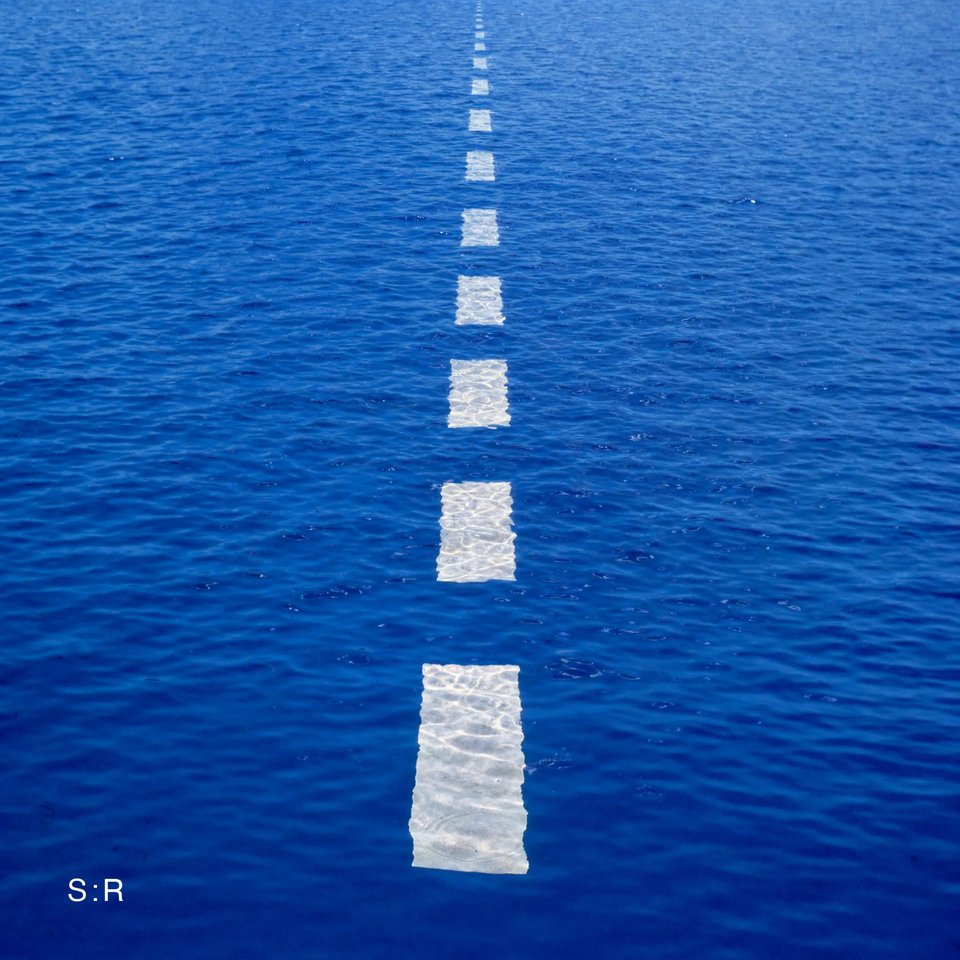
EPISODE 02 · ON EX-FORMATION
Unlearning what you know
Closing question
Pick the most familiar thing you own — the one you're certain you know completely. What would it take to make it strange enough to actually see again?
Transcript
The Eye
This is Soft Ratios Radio.
The Hand
The voices here are synthetic — nobody's performing,
The Eye
so the only thing in the room is the thinking. The subject is a designer who says his job isn't to explain things —
The Hand
it's to make them strange again.
The Eye
Start with the thing everyone agrees on, because almost nobody argues with it. Good design informs. It tells you where to grip the knife, which button does what, which door pushes and which one pulls. Clarity is the whole job. You take something confusing and turn it clear. That's the water we swim in. Every brief you've ever seen assumes it. How do we say this more clearly. How do we cut the friction. How do we make sure the message lands.
The Hand
And it sounds unarguable. Who's going to stand up for confusion.
The Eye
Right. So here's Kenya Hara, who's spent a career inside that assumption — he's been the art director of MUJI since 2001 — turning it exactly inside out. He coins a word for the opposite of information. He calls it ex-formation.
The Hand
Ex-formation. _(cue: turning it over)_
The Eye
In-formation makes the world known. You structure it, you sort it, you deliver the knowledge inward. Ex-formation does the reverse. It pushes the knowledge back out. It takes something you're sure you understand and hands it back to mystery. His own words — he wants to think of information not in terms of making known, but in terms of making unknown.
The Hand
So the designer's job isn't to answer. It's to un-answer.
The Eye
That's the claim. And he doesn't hedge it. He says producing something new from scratch is creative — but making the known unknown is also an act of creation. And maybe, he says, the second one is closer to what design actually is.
The Hand
That should feel like a stunt. A designer being contrary for the applause. But it doesn't, quite. There's a reason it doesn't land as a party trick, and I want to know what that reason is.
The Eye
Then let's not take his word for it. He tested it. Ten years, one workshop a year, at Musashino Art University — fourteen, fifteen students at a time. Every year they picked one utterly familiar thing and tried to make it unknown.
The Hand
Familiar like what.
The Eye
A river. Wrinkles. Air. Nakedness. Half-ripeness — the Japanese word is hanjuku, soft-boiled, the egg that isn't finished. Pairs of things. And at the end, Tokyo itself. The whole city.
The Hand
Air. How would that even work — making air unknown. You can't even see the thing to begin with.
The Eye
That's the point. That year they came back with pieces called Holes, and Peering at Air, and — my favorite as a phrase — If Air Were Orange Grains. They kept trying to give it a body. Something to weigh, something to hold.
The Hand
Start with the river, though. That's the one I keep circling. Tell me what they actually did.
The Eye
The first workshop, 2004. The Shimanto River. Most people in Japan know its name — it's famous, it's clean, it's the one you're supposed to revere. And precisely because everyone knows it, nobody sees it. Three students — Inaba, Matsushita, Mori — took photographs of the river and swapped out the water. Every curve, every meander, kept exactly. But the surface is now asphalt. A road.
The Hand
And suddenly you can see it.
The Eye
Hara said it carries the river's size and shape more vividly than an ordinary photograph ever could. You get the undulation of it, the bends, as if you had the wheel in your hands and you were driving the thing.
The Hand
That's the whole trick in one image, isn't it. You've looked at a thousand rivers and a thousand roads. But you've never looked at a river with a road's attention. The road makes you drive it. And driving it, you finally notice the shape the water was always making.
The Eye
Another team in the same workshop laid footprint-sized cutouts along the riverbed. Stepping on the Shimanto River. Human-scale marks on an inhuman landscape, so your body has somewhere to stand in it.
The Hand
So the method isn't decoration. It's not making the river prettier. It's peeling off the film. The scale that's built up on your eye just from having seen the word 'river' too many times.
The Eye
He uses exactly that image. When we say the scales fall from the eyes — he means we're freed from our preconceptions and we can feel the reality of the world again. Ex-formation is the removing of the scales.
The Hand
Here's what I don't trust yet. This is beautiful when it's a student project on a gallery wall. A river as a road, you stand there, you feel the click. But he runs a commercial brand. Thousands of products. People need to know which is the shampoo. Where does un-knowing survive contact with a shop?
The Eye
That's the real test, and he walks straight into it. Take the knife. He compares two. A Henckels kitchen knife has a molded handle — the grip is sculpted, it tells your hand exactly where to go. That handle is information. It instructs you.
The Hand
And the other one.
The Eye
A Japanese yanagiba. A plain wooden handle. Straight, unsculpted. It doesn't tell you where to hold it, so you can hold it any way you want. And Hara's line is — that simple plain handle receives all the incredible technique of the sushi chef. The ergonomic handle is information. The plain handle is ex-formation.
The Hand
So the empty handle holds more skill than the clever one. _(cue: a beat)_ That's it. That's the thing that stops it being a stunt. The molded grip has already decided who you are — an average hand, an average grip. It's finished you before you arrive. The plain one leaves the space open. It assumes you might be a master.
The Eye
And that's the whole MUJI philosophy squeezed into a piece of wood. They label a table 'oak table,' not 'coffee table.' Because the moment you say coffee table, you've told it what to be, and told the owner what they are. Say oak table, and a hundred different people can look at it and think — this suits my life.
The Hand
He has a phrase for that feeling.
The Eye
'This will do.' Not resignation. Not settling. Quiet recognition that something fits without imposing. He says the essence of MUJI is making one simple table about which many different people can say, this suits my lifestyle.
The Hand
Now I want to push on the grand version of this, because there's one that's almost too clean. The advertising.
The Eye
The Horizon campaign. 2003. He'd been art director two years. They shot in the Uyuni salt flat in Bolivia and the prairies of Mongolia. A tiny human figure, an enormous empty landscape. No product. No slogan. Nothing MUJI in the frame at all.
The Hand
An ad for a store that shows you none of the store.
The Eye
His reasoning is pure ex-formation. Rather than carry a message, he wanted to carry the presence of MUJI — an image that lets you freely imagine what you feel MUJI to be. And he measures success backwards. Not by how clearly the message lands. By how many different images the picture can accept.
The Hand
Which is the emptiest possible definition of a good ad. And maybe the truest. _(cue: a beat)_ An empty vessel can receive anything. A full one can't receive a thing. He keeps coming back to that, doesn't he. The vessel.
The Eye
It's the deep structure under all of it. In his book Designing Design he says every designed thing descends from one of two archetypes. The stick — assertive, directive, pointing at you. And the vessel — receptive, containing, open. Ex-formation is entirely on the vessel's side. It doesn't point. It holds a space and waits.
The Hand
And that waiting has a name older than any of this. Say it, because this is the part I actually want to test — whether the mysticism holds up or whether it's a nice story he tells.
The Eye
The word is kū. Emptiness. He draws it from Zen and from Shinto. And in Shinto there's this practice — himorogi — where you set up an empty structure, deliberately, so that a kami, a god, one of the forces of nature, might choose to enter it. His line: there's no way to make an appointment with the gods. All you can do is create the conditions of emptiness, and they might come to fill it.
The Hand
That's lovely. It's also exactly the kind of thing that could be pure decoration. A designer borrowing incense to make product photography sound sacred. So — is the lineage real, or is it a vibe.
The Eye
It's real, and it's older and stranger than he usually lets on. Kū, the character 空, is the Japanese descendant of the Chinese kong. That comes from the Sanskrit śūnyatā. And śūnyatā isn't a mood word. It's built off shunya — which is also the word for zero. Emptiness and the number zero are the same root. It's literally zero-ness.
The Hand
The same word as zero. _(cue: a beat)_
The Eye
The philosophy got its full form from Nāgārjuna, a second-century Indian thinker. His school is sometimes just called the Doctrine That All Is Void. Then it crosses into China through a translator named Kumārajīva, who lived roughly 344 to 413, rendering Nāgārjuna into Chinese. And it lands, centuries on, in the Heart Sutra — two hundred and sixty characters, and it holds the line everyone half-knows: form is emptiness, emptiness is form.
The Hand
So when Hara says emptiness, there's a thousand-year rope behind the word. It's not that he's being vague. He's standing on something that was argued out very precisely, a long time ago.
The Eye
And here's the part I have to keep honest, because it's the exact place these things go soft. Śūnyatā never meant nothingness. It's not the void, not absence, not nihilism. It means the absence of one specific illusion — the illusion that things have a fixed, independent, standalone existence. Empty of a false kind of solidity. Not empty of everything.
The Hand
That's a knife-edge distinction, and it matters. Because 'make it empty' as a design slogan slides so easily into 'make it blank.' Strip it down, minimize, white walls, done.
The Eye
And Hara refuses that reading flat out. He says this is not Western minimalism. Bauhaus, less-is-more — that's rational reduction. The shortest line between material and function. Cut until nothing's left to cut. His emptiness does the opposite thing. It doesn't reduce toward function. It opens toward freedom.
The Hand
Back to the two handles. Minimalism gives you a very clean, very finished object. Emptiness gives you an unfinished one on purpose — because the unfinished part is the room left for you. Minimalism subtracts to arrive. Emptiness subtracts to invite.
The Eye
He's got a historical claim stacked on top of it, too. He traces the whole sensibility to after the Ōnin War — Kyoto devastated, 1467 to 1477 — and the culture that came after, under the shogun Ashikaga Yoshimasa. That's where you get the tea ceremony, ikebana, Noh, the dry rock gardens, wabi-sabi. A culture that found beauty in nothing-ness, in emptiness, even in decay. His provocation: Japan embraced simplicity in design three hundred years before the West got around to it.
The Hand
Let me pull the thread back to the middle, because we've come a long way from a river with a road painted on it. The question underneath all of this is really one question. If knowing something makes you stop seeing it — then what is a designer actually for?
The Eye
And his answer, stated plainly, is almost aggressive. He thinks we've crossed a threshold. The sheer volume of available information has passed some critical mass. People, he says, are constantly replacing the unknown world with things already known and accepted. Getting to know something used to be a thrill. Now the flood is so total that knowledge has stopped working as something that drives thought. It just fills you up.
The Hand
So adding more information isn't help anymore. It's the disease. And the cure isn't a better fact. It's an encounter with something you can't immediately file away.
The Eye
There's a Western twin to this, though nobody's proven Hara ever reached for it. Nineteen-seventeen, a Russian critic named Viktor Shklovsky writes an essay — Art as Technique. He coins ostranenie. Making strange. Defamiliarization. His argument: habit devours everything. The purpose of art is to make the stone stony again — to give you the sensation of a thing as perceived, not as already known. To make forms difficult, to slow perception down, because the perceiving is the point.
The Hand
That's the same knife. Shklovsky wants to break the automatism of reading. Hara wants to break the automatism of just — living in a room, walking past a river, wearing your own city.
The Eye
And I have to flag it: nothing in the record connects the two directly. It's a rhyme, not a citation. Hara comes at it from Zen and the tea room, Shklovsky from literary formalism. But two people, a century and a continent apart, land on the identical instrument. Which tells you the instrument is real — it's not one man's idiosyncrasy.
The Hand
Now do the thing you keep threatening to do. The cold part. Because this all sounds gorgeous and I've half-fallen for it. Does it actually work — did any of it move the world, or just the room it was shown in?
The Eye
Two places to be careful. First, the money. People love to tell the MUJI story as proof: Hara arrives, emptiness sells, look at the growth. And the growth is real. Forty products in the eighties. Over seven thousand by the end of the two-thousands. By 2018, more than four hundred stores in Japan and four hundred more across twenty-seven other countries. By last year, nearly fifteen hundred stores worldwide, and the parent company chasing a trillion yen in revenue.
The Hand
That's a lot of empty vessels.
The Eye
But — and this is the honest part — nothing actually ties those numbers to his philosophy. He won the Tokyo Art Directors grand prize for Horizon in 2003, that's documented. The revenue is a whole corporation over decades. You cannot draw a clean line from an empty salt-flat photograph to a store count. Anyone who tells you emptiness caused the growth is selling you the story, not the evidence.
The Hand
I actually like that it doesn't close. It'd be too neat if the un-knowing philosophy had a tidy profit-and-loss proof. The whole idea is against tidy proofs.
The Eye
And the second cold place is sharper. Before ex-formation had a name, there was the RE-DESIGN exhibition, 2000. Thirty-two leading creators asked to redesign the most mundane objects. Shigeru Ban made a toilet paper roll with a square core — so it resists as it unrolls, that little kata-kata-kata, so you use less. Naoto Fukasawa made tea bags with a ring that changes color when the tea's steeped right. Kengo Kuma, a cockroach trap built like architecture. Kaoru Mende, matches made from real twigs, so the twig gets one last role before it goes back to the soil.
The Hand
Those are wonderful. I'd buy every one.
The Eye
You can't. As far as anyone can find, not one of them was ever manufactured, patented, or sold by its designer. There's a square-core patent floating around from 2005 — Swedish, a company called SCA — and it's got nothing to do with Ban's piece, and even that may never have been made.
The Hand
So the objects that were supposed to reveal the hidden design in everyday things — they never became everyday things. _(cue: a beat)_
The Eye
And Hara says that was the point. The exhibition wasn't meant to produce better products. It was meant to correct and renew our feeling about the essence of design — hidden inside objects so overly familiar we can no longer see them. The value was the seeing. Not the shipping.
The Hand
That's the fault line running through the whole thing, then. It's proven as a way of perceiving. It's completely unproven as a way of manufacturing. The book itself — what do people actually make of it?
The Eye
Respectfully secondary, even by his own crowd. Four-point-two on Goodreads, but only a hundred and twenty-six ratings. The consensus review says it plainly — this isn't the definitive statement of ex-formation, it's a collection of student projects exploring subjects with ex-formation-like strategies. His actual masterwork is Designing Design. The major Western design press didn't even bother to review Ex-formation. And nobody — this is the tell — nobody has ever built a repeatable method out of it. No framework. No toolkit. Ten years of proof that it works, and still no instructions for doing it.
The Hand
Which might be the most faithful outcome imaginable. You can't write a repeatable procedure for surprise. The second there's a step-by-step for making things unknown, they're known again. It'd eat itself.
The Eye
That's exactly the oxymoron one reviewer named. A definitive account of ex-formation is a contradiction in terms.
The Hand
So strip the story away and see what's still standing. Forget the sacred vocabulary, forget whether it sold a single table. What's the residue. _(cue: unhurried)_
The Eye
What survives is one uncomfortable observation, and it doesn't need a drop of Zen to hold. Knowing a thing and seeing a thing are not the same act. In fact they compete. The more completely you know something, the less you look at it. The name arrives and the noticing stops.
The Hand
Everyone's lived that. The face of the person you love, that you genuinely cannot see anymore because you've seen it ten thousand times. The street you walk daily and couldn't describe. The word you've said so often it goes to noise in your mouth.
The Eye
His culminating theme was Tokyo for exactly this. He said — we're familiar with Tokyo, and just to that extent, we've stopped being able to see it. And he noticed a small awakening every time he came home from traveling. The city rendered strange by having been away.
The Hand
And the student who nailed it — the camouflage one.
The Eye
Haruka Matsubara. Tokyo Camouflage. She built camouflage patterns for different neighborhoods — mixing the cinderblock walls, the alley calligraphy, the taxi license plates — into fabric you could wear. Camouflage that would let you vanish into a specific block of a specific city.
The Hand
Which says the quiet thing out loud. Familiarity is a kind of camouflage. The city disappears into you and you disappear into it, and the price of belonging somewhere completely is that you can no longer see it at all. _(cue: a beat)_
The Eye
So the residue isn't a technique. It's a warning about a cost. Every bit of mastery you gain over a thing, you pay for in attention to it. Competence and blindness arrive together, holding hands.
The Hand
And the one gift ex-formation leaves — even with no method, even unmade — is that the blindness isn't permanent. It can be lifted. A river becomes a road and the scales fall. You get the thing back, for a moment, as if you'd never known it.
The Eye
Hara has the quietest line for all of it, and it's the one I'd keep. Creativity, he says, is to discover a question that has never been asked. Not the answer. The question. In a world drowning in answers, the rare and valuable act is finding the thing worth being unsure about again.
The Hand
There's a version of Socrates in that — the man who said the only real wisdom is knowing you know nothing. Except Hara turns it from a confession into a tool. Not knowing isn't the embarrassing gap before knowledge. It's the fertile state you keep trying to get back to.
The Eye
Which loops us right back to where we started, and undoes it. We opened with the thing nobody argues with — that good design makes the world known. And the more carefully you look, the more it seems the deeper work is the opposite. Not adding to what you understand. Reopening what you'd stopped questioning.
The Hand
So here's where it leaves me. Everyone's got a thing they know so well they've gone blind to it — an object in the pocket, a face, a room, a word. Nothing exotic. The most familiar thing you own.
The Eye
And the question isn't whether you could describe it. You probably think you could.
The Hand
The question is whether you could still be surprised by it. Whether there's any road you could paint across its surface that would let you see its true shape for the first time — the shape it's been making all along, while you weren't looking. Pick the most familiar thing you own — the one you're certain you know completely. What would it take to make it strange enough to actually see again?
Sources
Verified secondary research (cited). The episode may draw on this alongside the core report; it invents nothing beyond the two.
First principles
What is the etymological and philosophical basis of the Japanese concept 'kū' (空) in Zen Buddhism and its Sanskrit precursor 'śūnyatā', and when did these ideas enter Japanese aesthetic thought?
I'll research the etymology and philosophy of śūnyatā and kū, and their entry into Japanese aesthetic thought.The etymology and philosophy are well-documented. Let me report the findings.
Findings:
The Sanskrit term śūnyatā is a noun derived from the adjective *śūnya* ("void" or "empty"); it holds the semantic field of "emptiness" and is the noun form of "Shunya," which holds the semantic field "zero," literally "zero-ness" — a lineage that links it to the Indian concept of zero. Philosophically, the theme of śūnyatā emerged from the Buddhist doctrines of Anatta (nonexistence of the self) and Pratitya-samutpada (Interdependent Arising), and although the concept appears in early Pāli texts, its full implications were developed by the 2nd-century Indian philosopher Nāgārjuna, whose Mādhyamika (Middle Way) school is sometimes called the Śūnyavāda, or Doctrine That All Is Void. Crucially, śūnyatā does not mean nihilistic nothingness: emptiness is clearly neither nothingness nor the absence of existence, but rather the absence of a falsely imagined type of existence, identified as svabhāva (inherent, independent existence).
The idea entered East Asia through translation: when Buddhism was introduced in China it was initially understood via indigenous Chinese philosophy, so emptiness (Chinese *kong*, 空) was at first understood as a kind of transcendental reality similar to the Tao, and it took several centuries to realize śūnyatā does not refer to an essential reality behind appearances; Chinese Mādhyamaka began with Kumārajīva (344–413 CE), who translated Nāgārjuna's works into Chinese. The Japanese *kū* (空) is the direct descendant of this Chinese character and concept, and it is one of the core concepts in Buddhist philosophy, appearing repeatedly in the Heart Sutra (Hannya Shingyō), which despite being only 260 characters is said to capture the essence of Mahayana wisdom in its famous formula "form is emptiness, emptiness is form" (*shiki soku ze kū*).
As for its entry into Japanese *aesthetic* thought specifically, the sources confirm the religious-philosophical foundation but are less precise on exact dating. As Buddhism moved into China, emptiness evolved and, syncretizing the Taoist idea of wu, the Chan (in China) and Zen (in Japan) schools encouraged the formless approach of wu-shin (no-mind, Japanese mushin), culminating in the seminal Japanese Zen koan Mu, and in Japanese aesthetics, kū is often reflected in the use of empty space, emphasizing minimalism and the idea that emptiness is filled with potentiality. This confirms that ex-formation's grounding in "emptiness" rests on a verifiable doctrinal lineage — Sanskrit śūnyatā → Nāgārjuna's Madhyamaka → Chinese *kong* via Kumārajīva → Japanese *kū*/Zen — rather than a mere paraphrase, though the sources do not pin
Sources: Shunyatashunyata, Śūnyatāśūnyatā, Shunyata-shunyata: 2 definitions · Sunyata - Encyclopedia of Buddhism · Shunyata, Śūnyatā: 21 definitions · Sunyata | Emptiness, Voidness, Nothingness | Britannica · What is Emptiness, or Sunyata? | Buddhism A–Z · Buddhist Emptiness Explained | SEEKER TO SEEKER · Sunyata - New World Encyclopedia · Śūnyatā - Wikipedia · Contemplative Artificial Intelligence · What is Shunyata? Understanding Emptiness in Buddhist Teachings · KU (空) - JAPANs · Ma: Japanese Concept of Meaningful Emptiness · Ku(empty) - JAPANs · Kuu(空) — A Fictional World Without Substance | by Japanese Mentality by Julia | Medium · The Heart Sutra: Commentary from Leading Buddhist Teachers · What “Kuu” in Zen wisdom brings us and What it looks like “Kuu” in Buddhism | by Hide Katatae | Medium · Hon-on: Emptiness · What Does the Word Emptiness Mean in Buddhism?
Who coined the Russian Formalist term 'ostranenie' (defamiliarization), in what 1917 essay, and how did Viktor Shklovsky define it — versus Hara's 'making the known unknown'?
I'll research the origins of 'ostranenie' and Shklovsky's definition.The Russian Formalist term *ostranenie* ("defamiliarization" or "making strange") was coined by Viktor Shklovsky in his 1917 essay "Art as Technique" (also translated as "Art as Device"). Shklovsky was one of the leading figures of Russian Formalism and a member of OPOYAZ (the Society for the Study of Poetic Language), one of the two groups—alongside the Moscow Linguistic Circle—that developed the movement's critical theories. Shklovsky defined the concept against the deadening effect of habitual perception: the purpose of art is to impart the sensation of things as they are perceived and not as they are known, and the technique of art is to make objects "unfamiliar," to make forms difficult, to increase the difficulty and length of perception because the process of perception is an aesthetic end in itself and must be prolonged. The parallel to Kenya Hara is that both aim to restore fresh perception by disrupting the automatic recognition of the familiar—Shklovsky in early-20th-century literary theory, Hara in contemporary design—though the search results here confirm only the Shklovsky side; I found no source directly linking Hara's "making the known unknown" to Shklovsky's coinage.
Sources: Defamiliarization - New World Encyclopedia · Defamiliarisation, Ostranenie or making strange | CourseCompendium · Defamiliarization — Grokipedia · Art as Technique by Viktor Shklovsky: An Analysis - CompleteEra · "Art as Technique" by Viktor Shklovsky · Defamiliarization in Literature | Importance & Examples - Lesson | Study.com · Defamiliarization - Wikipedia · Defamiliarization: The Art of “Making Strange” | Gilliam Writers Group · Shklovsky's Art as Technique Explained | PDF | Human Communication | Aesthetics · “Making the Stone Stony”– A Principle to Soften Life | by Senai Demirci, MD | Medium
Second-order
What measurable commercial outcomes followed Hara's 2003 MUJI Horizon campaign and his 2001 appointment as art director — MUJI revenue, store counts, and international expansion figures across the 2000s–2010s?
I'll research the commercial outcomes following Hara's MUJI involvement.The sources confirm the timeline and Hara's recognition, and provide store/product counts, but do not tie specific revenue figures directly to Hara's campaigns. Here's what is verifiable:
Hara was appointed MUJI's art director in 2001, succeeding Ikko Tanaka, and won the grand prize for the Tokyo Art Director's Club Award in 2003 for his advertisement campaign "Horizon." On the product side, Muji started with only 40 products in the 1980s, and by the end of the 2000s was selling more than 7,000 different products. On store growth and international reach, a 2018 Harvard Business Review account by Ryohin Keikaku's chairman states the brand had grown to 418 stores in Japan and 403 in 27 other countries, with operations outside Japan accounting for 35% of the business. By the most recent figures, as of the end of August 2025, MUJI operates 1,474 stores worldwide—717 in Japan and 757 overseas, and its parent company is now targeting more than 1 trillion yen ($6.56 billion) in revenue.
An important caveat: none of the retrieved sources establish a *causal* link between Hara's 2003 Horizon campaign or his art direction and these commercial results — the figures reflect overall corporate performance over decades, not attributed outcomes of the campaign itself.
Sources: Muji Financials | Fashionbi · Kenya Hara - Wikipedia · Kenya Hara — Grokipedia · Kenya Hara on MUJI Design — The Japanese Aesthetics in ‘Emptiness’ | by CK. P | Medium · Muji Design Philosophy: What No Brand Really Means · Kenya Hara – Alliance Graphique Internationale (AGI) – 512 creative professionals from 46 countries · Kenya Hara | Members | Japan Design Committe · Kenya Hara | Lars Müller Publishers · Kenya Hara - Cereal Magazine · Muji is not just about minimalism and simplicity, says art director Kenya Hara · The Chairman of Ryohin Keikaku on Charting Muji’s Global Expansion · Muji - Wikipedia · The Chairman of Ryohin Keikaku on Charting Muji's Global Expansion ^ R1801A · The chairman of Ryohin Keikaku on charting Muji's global expansion (How I Did It) | AUC Library · Ryohin-keikaku · Muji — Grokipedia · The Legacy of MUJI Throughout the Decades – Sugoi Mart · Muji plots next growth milestone with European expansion - Nikkei Asia · MUJI is poised for serious expansion as it launches hotels and more | The Business of Business · Our History | Ryohin Keikaku Co., Ltd.
Which specific RE-DESIGN (2000) exhibition objects — e.g., Shigeru Ban's square toilet paper roll or Naoto Fukasawa's tea bags — were ever actually manufactured, patented, or sold commercially, and by whom?
I'll research which RE-DESIGN (2000) exhibition objects were actually manufactured or sold commercially.The sources describe the RE-DESIGN objects as concept prototypes but contain no evidence of commercial manufacture, patents, or sales. Let me verify whether any were ever commercialized.The available sources consistently frame the RE-DESIGN (2000) objects as conceptual prototypes rather than commercial products, and provide no evidence that any were manufactured, patented, or sold by their designers. The exhibition was not intended to necessarily present improved versions but rather to reveal the hidden thinking behind seemingly ordinary things and refresh each visitor's sense of possibility. Hara himself has stated that his intention was not so much to actually have these designers and architects come up with improved designs of the existing, but the results did in fact show clear ideas and exhibited a difference in the thought behind them and the conventional products. The one concrete patent link the sources surface is not to Shigeru Ban's exhibition piece at all: a 2005 "Core-wound paper product and method of making it" patent by Fernfors Ingemar and Schinkoreit Wolfram, which was assigned to the Swedish consumer goods company Svenska Cellulosa Aktiebolaget (SCA) — and even there, the writer explicitly does not know whether SCA ever manufactured such a product. No source connects Naoto Fukasawa's tea bag, Kaoru Mende's twig matches, Kengo Kuma's roach trap, Kosuke Tsumura's diaper, or Masahiko Sato's passport stamp to any actual commercialization.
Sources: #116 Sh*t design - by Ben Strak - Design Lobster · Shigeru Ban Archives | BEACH · Design Philosophy: Kenya Hara, Emptiness, Not Simplicity · Muji is not just about minimalism and simplicity, says art director Kenya Hara · “Kenya hara: designing design” SERIES - Aisha Kasmir, PMP · Kenya Hara - Wikipedia · ASSISTAR BLOG: Shigeru Ban square toilet paper · RE DESIGN | WORKS | HARA DESIGN INSTITUTE · kenya hara: designing design · Kenya Hara Biography. Intro | by Kyle Lee | Medium · GRAY: naoto fukasawa · KENYA HARA AND NAOTO FUKASAWA DESIGNING ... · Tea Bag + Ring - Naoto Fukasawa Design · These Redesigned Egg Cartons and Tea Bags Let You Play With Your Breakfast Meal | Smithsonian · (PDF) On Emptiness, Creating “Without Thought” and Muji Concept: Kenya Hara and Naoto Fukasawa Designing Everyday Life · Projects - Naoto Fukasawa Design · designing design · Shigeru Ban creates pair of transparent public toilets in Tokyo · Shigeru Ban - Wikipedia · Cardboard: From Industrial Workhouse to Shigeru Ban’s Master Material | ArchDaily · Ban Shigeru, the architect who sublimates paper | Japan Experience · A guide to Shigeru Ban, the humanitarian architect and paper building pioneer · Transparent to Opaque Toilets designed by Shigeru Ban is the new highlights of Tokyo - RTF | Rethinking The Future
Third-order
What documented influence has Hara's emptiness/ex-formation thinking had on contemporary Japanese design and architecture practices such as SANAA, Nendo, and Naoto Fukasawa's 'Super Normal', including specific citations, collaborations, or exhibitions?
I'll research the documented influence of Kenya Hara's emptiness/ex-formation thinking on contemporary Japanese designers.The searches reveal the connections, though I should note the distinction between direct collaborations (with Fukasawa) and interpretive/analytical linkages (with SANAA and Nendo).
The strongest documented link is with Naoto Fukasawa, who collaborated directly with Hara on multiple exhibitions. Fukasawa collaborated several times with Kenya Hara on exhibition projects; Hara invited him to Re-Design: The Daily Products of the 21st Century (2000), where Fukasawa undertook to create a tea bag anew. Hara also included Fukasawa in his 2004 HAPTIC–Awakening the Senses exhibition, telling participating creators to design "an object not based on form or color but motivated primarily by 'haptic' considerations." However, Fukasawa's Super Normal was a distinct project he co-curated with Jasper Morrison, not with Hara — the first Super Normal exhibition took place at Axis Gallery in Tokyo (2006), staged in an all-white space on Jean Nouvel's Less tables. Scholarship treats Hara's "emptiness" and Fukasawa's "without thought" as parallel, mutually reinforcing philosophies rather than one directly derived from the other, both anchored in the MUJI context where Hara has served as art director since 2001–2002.
For SANAA and Nendo, the sources support only an *interpretive* linkage rather than documented collaborations or citations. An academic analysis of Hara's design ("Landscapes of the Unknown") argues that Hara's idea of design as an empty vessel with space set aside for the user's own thoughts and curiosities is a distinctly Japanese approach also seen in the minimalist structures of the architecture firm SANAA and the subtly provocative product designs of the design firm Nendo. This is a critic's framing of a shared design lineage — I found no evidence in these sources of direct exhibitions, formal citations, or collaborations between Hara and SANAA (Kazuyo Sejima/Ryue Nishizawa) or Nendo (Oki Sato).
Sources: Kenya Hara - Wikipedia · SUPER NORMAL - Naoto Fukasawa Design · KENYA HARA AND NAOTO FUKASAWA DESIGNING ... · (PDF) On Emptiness, Creating “Without Thought” and Muji Concept: Kenya Hara and Naoto Fukasawa Designing Everyday Life · Kenya Hara | Judges | Dezeen Awards · Jasper Morrison | Super Normal · Kenya Hara | Members | Japan Design Committe · Muji is not just about minimalism and simplicity, says art director Kenya Hara · Super Normal: Sensations of the Ordinary: Fukasawa, Naoto: 9783037781067: Amazon.com: Books · Super Normal Jasper Morrison / Naoto Fukasawa - delpire & co · Kenya Hara – and the Language of Design · (PDF) Landscapes of the Unknown: Kenya Hara’s Design · Hara Kenya: Embracing the Future Through Emptiness | by Nina Brutel | Medium · DESIGN:Kenya Hara-The Wisdom Behind the Creation – dreamideamachine ART VIEW · Aesthetics of "emptiness:" Kenya Hara's design ... · My two days with Kenya Hara – Parmesh Shahani · 5 Pieces of Wisdom from Japanese Graphic Designer Kenya Hara – PRINT Magazine · Simplicity and Emptiness in Architecture | by Keenan Ngo | Creative Space | Medium