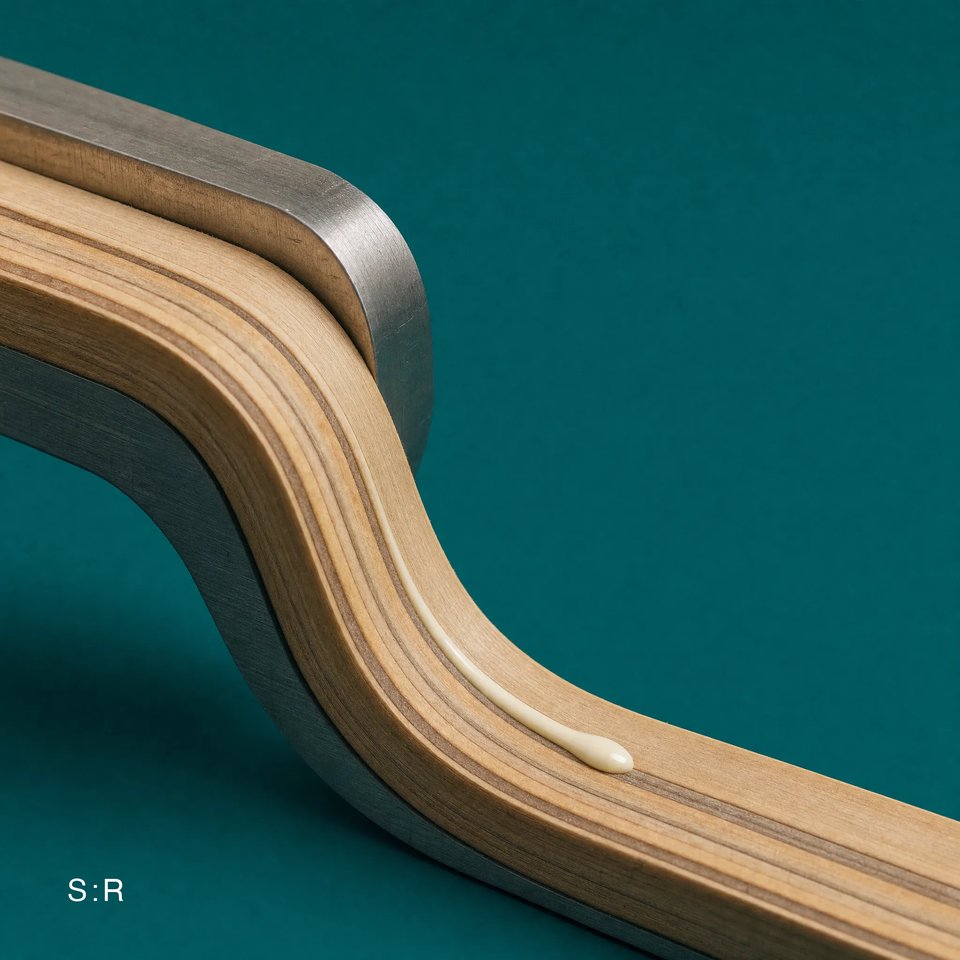
EPISODE 09 · ON PLYWOOD
Wood turned against itself
Closing question
When did we decide that a thing showing us exactly how it was made is a reason to trust it less?
Transcript
The Eye
This is Soft Ratios Radio.
The Hand
The voices are synthetic — no act, just the thinking.
The Eye
Hoyd Breton, a designer at Soft Ratios Studio, teaching himself in the open.
The Hand
One subject at a time. Today, plywood. There's a thing people say in a workshop, and they say it like an apology. 'It's only plywood.' Like it's what you reach for once you've run out of the real stuff. _(cue: unhurried)_
The Eye
The prejudice is old enough to have a literary monument. Dickens, in Our Mutual Friend, gives us a family called the Veneerings — new-money climbers, all surface, a bright thin skin over not much. Veneer as a moral category.
The Hand
And that's the tell. He didn't have to explain the joke. By the middle of the nineteenth century everyone already knew veneer meant fake.
The Eye
It was everywhere by the 1880s, and almost always hidden. Put in structurally, where you couldn't see it, or buried under a facing of something more respectable. The industry's own history is a story of a material ashamed of its face.
The Hand
Here's what I can't square, then. If it was cheap and shoddy, why was it doing the structural work? You don't hide your weakest thing inside the wall. You hide it because you don't want to look at it — not because it can't hold.
The Eye
That's the whole inversion. The thing dismissed as a cheap substitute is, in the ways that matter to an engineer, better than the solid wood it stands in for. Not cheaper-and-worse. Cheaper — and in some directions stronger.
The Hand
Better. Say that carefully, because every part of me that likes wood wants to argue with you.
The Eye
Then I'll be careful. Start with what wood actually is. A tree is a bundle of straws running up the trunk — fibres all pointing the same way. That's why it splits so willingly along the grain and fights you across it. Engineers have a word for it — orthotropic. Wood has three directions and behaves differently in each. Along the grain it's phenomenally stiff. Across it, feeble by comparison.
The Hand
How feeble? Give me the size of it.
The Eye
In the stiffness the Forest Products people measure, along-grain against across-grain runs something like ten to one, twenty to one, depending on species. One bending study put the along-grain specimens near eleven gigapascals and the cross-grain ones under two — five times weaker, same wood, just turned ninety degrees.
The Hand
So the material isn't strong or weak in itself. It's strong in one story it tells about itself and feeble in every other.
The Eye
And solid timber makes you live with that. A wide board wants to move — swell and shrink across the grain with every damp week, cup, split, check at the ends. All of it is the grain having its way.
The Hand
So the trick is to stop letting it have its way.
The Eye
The trick is to turn the wood against itself. Slice it into thin sheets — veneer — and stack them so the grain of each layer runs perpendicular to its neighbours. An odd number of layers, always odd, so the outer two pull the same direction and the whole panel stays in balance.
The Hand
Why odd?
The Eye
Symmetry. If the two faces disagree, the panel bows. An odd count keeps the skins in agreement and the stresses cancel toward the middle. You can have an even number of plies — you double up a core — but the layer count, the count that matters, stays odd.
The Hand
And the perpendicular part does what, exactly.
The Eye
Each layer's weakness is the next layer's strength. Where one sheet would split, the sheet glued crosswise to it refuses. So you take a material that was ten-to-one lopsided and you make it — not equal, but even. Nearly the same along and across. Stable both ways. So untroubled by splitting that a screw a few millimetres from the edge still holds.
The Hand
Even. That's the word I keep turning over. Because a plank has a best direction, and a good hand learns it — you read the grain, you plane with it, you cut a joint that respects it. There's a whole craft that's really just a long conversation with the grain, asking it which way it wants to go. And plywood ends that conversation. It has no best way. It's the same in your hand whichever way you turn it. Part of me hears that and thinks something's been lost. The wood used to be a partner. Now it's just — obedient. But then I hear myself, and it sounds like nostalgia for a problem. The cupping, the splitting, the board that twists in a wet spring — I don't miss those. I miss the intimacy of fighting them. So maybe evenness isn't the loss of character. Maybe it is the character. A material that behaves the same everywhere is its own kind of honest.
The Eye
That evenness had to be manufactured, though, and for most of history nobody could. The idea is ancient. The making is what took forever. The oldest example we have is a coffin. Third Dynasty Egypt, around 2600 BC, pulled from an alabaster sarcophagus in a passage of the Step Pyramid at Saqqara. Six layers of wood, each about four millimetres thick, grain deliberately alternating — the inner boards running vertical, the outer horizontal.
The Hand
Glued?
The Eye
No — that's the beautiful part. No glue yet. They held the layers with flat wooden dowels pinned by tiny wooden pegs. Cross-grain lamination, forty-six centuries ago, entirely mechanical.
The Hand
Why go to all that trouble in a tomb? You'd think a coffin is the one place you'd use your best solid plank.
The Eye
Timber was scarce and mostly imported. None of their pieces were long enough for the length or wide enough for the sides, so they built up what they needed from short strips — and once you're piecing it anyway, cross-graining it makes it stronger and keeps it from warping. Economy invented the technique. And there's a later reading that it's less a plain plywood than a careful assemblage — foreign and native woods, layered under gold foil.
The Hand
Even the first one is hiding under gold. The stigma predates the industry by four thousand years.
The Eye
The leap from a pharaoh's coffin to a material you can buy takes two machines and a great deal of patience. The first is the rotary lathe. You take a log — a peeler block, cut to about the width of the lathe, call it a hundred inches — mount it in a chuck, and spin it against a fixed knife. It peels one continuous ribbon off the whole circumference, like cloth coming off a bolt.
The Hand
A whole log unwound into one sheet. That's a strange image — the tree undone in a spiral.
The Eye
And you can't peel it cold. You cook the log first — steam or hot water for hours, sometimes days, to soften the wood so the veneer bends over the knife instead of shattering. The heat runs in from the ends about two and a half times faster than from the outside, which is the kind of detail that tells you how much hard-won craft is buried in something we treat as dumb sheet stock.
The Hand
So there's a peeling. What's the second machine?
The Eye
The dryer, and it's the unglamorous hero. Wet veneer used to be stacked on racks and lofts for days or weeks, warping and splitting as it went — you lost half your work to the drying. In 1902 the Coe company, an old Ohio firm that had been building steam engines and mill machinery since the 1850s, built the first roller dryer. Steel rollers carrying the veneer through flat, held flat, drying in minutes to half an hour instead of weeks.
The Hand
That's the whole difference between a curiosity and an industry. Somebody made the drying reliable.
The Eye
Which is exactly when the industry dates itself. March 1905, the Portland Manufacturing Company in St. Johns, Oregon. They made the first Douglas-fir panels as a 'something unusual' exhibit for the Lewis and Clark Exposition.
The Hand
How were they making them? If the dryer had only just arrived —
The Eye
Barely making them. Foul-smelling animal glue kept warm over a coal fire, brushed on by hand, the panels pressed in a rig improvised out of house jacks. One batch took most of a day to glue and had to set overnight. This is a garage operation dressed up for a fair.
The Hand
And it worked, as a fair trick?
The Eye
A man named Tom Autzen showed the panels to more than half a million people when the exposition opened that June. The customers who mattered were door manufacturers — flat, stable, cheap panels were exactly what a door wanted. The whole Pacific Northwest plywood industry grows out of a novelty booth.
The Hand
But animal glue over a coal fire — that's not a material you can put outdoors, or in an aeroplane.
The Eye
No, and that's the ceiling for thirty years. Plywood was strong and light and stable, but the glue was the weak link — hide glue, then early synthetics, all of which let go when they got wet. The material couldn't leave the dry indoors. The break comes in the mid-1930s, with a resin. Phenol-formaldehyde. The chemistry itself is older — it's Bakelite, 1907 — but getting it to work as a waterproof plywood glue took until the mid-thirties. James Nevin gets a waterproof adhesive going at Harbor Plywood in 1934; [pause] in Germany there's the Tego phenolic film around the same time. Suddenly you have exterior-grade plywood.
The Hand
And that one change is what lets it become an architect's material and an aircraft material almost at once.
The Eye
Almost the same decade, yes. But I want to be precise about the chemistry, because it comes back to bite us later. There are two formaldehyde resins in this world and they are not the same animal. Phenol-formaldehyde locks together with what chemists call methylene bridges — carbon links between rings of phenol. Those bonds barely notice water. It's the only truly exterior formaldehyde glue there is, and it cures hot, well over a hundred degrees, into a network that just sits there, stable, giving off very little. Urea-formaldehyde is the cheaper cousin. It bonds through nitrogen-to-carbon links, and those links are, chemically, an unlocked door. Warmth and moisture pull them apart. And when they come apart, the reaction hands formaldehyde back into the air. Water-resistant at best — fine for a cabinet in a dry room, not fine for weather, and not quiet over time. So the difference isn't cosmetic. It decides where each one is allowed to live. Structural plywood — the softwood sheathing in a wall, the subfloor under your feet — is phenol-formaldehyde. Sealed. The formaldehyde scare that everyone half-remembers is about the other one, urea-formaldehyde, in interior products: hardwood plywood, particleboard, the fibreboard in cheap furniture.
The Hand
So the good glue is the one that stays shut, and the suspect glue is the one that keeps leaking what it was made from.
The Eye
When California's regulators, and then Congress, built the whole formaldehyde regime — the 2010 federal act, the standards in force from 2018 — structural plywood is written out of it by statute. Exempt. Precisely because the phenolic glue emits so little there's nothing to regulate.
The Hand
Here's where I want to push, though. You've drawn a clean line — good glue, bad glue, and the scary stuff only in the cheap indoor board. But we flew men into combat in aeroplanes glued together. What held the Mosquito?
The Eye
The Mosquito is a fair hit. It's the great plywood aircraft — de Havilland's 'Wooden Wonder.' A frameless shell, built as two hollow halves like a giant model kit, a sandwich of Ecuadorian balsa between skins of Canadian birch plywood, formed in concrete moulds. _(cue: a beat)_
The Hand
And the glue.
The Eye
Early ones used casein — a milk-protein glue, genuinely poor in damp. They moved to a synthetic that was more durable. And that synthetic, Aerolite, was a urea-formaldehyde. The suspect cousin.
The Hand
So the neat story breaks. The very glue you've been calling interior-grade, not-for-weather, was flying reconnaissance over Germany.
The Eye
It was still an improvement on the casein, though — more durable, not less. And nobody built a wartime aircraft to last forty years in the rain; they built it to fly its missions. The line I drew is real, but it's a line about what a glue is for, not a verdict that one is poison. Urea-formaldehyde in a sealed, hot-pressed joint doing a job for a few years is a different question from the same resin quietly off-gassing in your bedroom furniture for a decade.
The Hand
Misaimed, then, not imaginary. The fear found the wrong target, but it wasn't nothing.
The Eye
That wartime moment is also where plywood stops hiding and gets celebrated — because the same properties that make a good aircraft skin make a new kind of furniture. If you can mould a compound curve out of a light stiff sheet, you can mould it to a body.
The Hand
This is the part I actually love, and it starts before the war, in a hospital. Alvar Aalto, designing a chair for a tuberculosis sanatorium in Paimio, around 1931, '32. The patients sat up all day trying to breathe. So he bent a single ribbon of plywood into a seat pitched at the exact angle that opens the chest. The form isn't a style — it's a lung, more or less. A shape reasoned out from a sick body, and only possible because the sheet would take a curve and hold it. He and his cabinetmaker patented the bend itself in 1933 — a way of bending wood — before there was even a company to make it. Artek came two years later. And then the war turns the same idea grim, and then tender, at once. The Eameses, 1942. Wounded servicemen were being carried in metal leg splints that vibrated in transport and did more damage to the leg they were meant to protect. Charles and Ray built a bending rig in their apartment — they called it the Kazam! machine — and moulded a splint out of plywood, formed over a plaster cast of Charles's own leg. So the first mass-produced object of their whole career is the exact shape of one man's leg, multiplied. The Navy ordered five thousand. By the end of the war something like a hundred and fifty thousand had been made.
The Eye
And in 1945 they take the machine they built for the splint and turn it back to a chair — the moulded plywood lounge chair they showed that December. The tooling for a wound becomes the tooling for comfort. Same curve, same material, different intention.
The Hand
That's almost too neat to be true, and it's true. The material that spent a century hiding under veneer finally gets to be the visible thing — the whole point is the curve you can see.
The Eye
So let me put the question back on the table, because we've been circling it. We started with 'it's only plywood.' And everything since — the cross-grain, the resins, the aircraft, the chair — says the opposite: this is one of the more considered materials we've ever made. So why does the flinch survive the evidence?
The Hand
Because we can see the seam. I think that's genuinely most of it. Solid wood hides its making inside a tree. Plywood shows you the layers right there on the edge — the stripes, the glue lines. It confesses that it's assembled. And we've decided, somewhere deep, that a thing that shows its construction is worth less than a thing that pretends it grew.
The Eye
There's a harder reason to be uneasy, though, and it isn't aesthetic. Follow the material out to its scale today and it stops being a charming design story. Plywood is enormous. Global production hit a record around 2017 — a hundred and sixty-one million cubic metres. And one country, China, made roughly three-quarters of it.
The Hand
That's not a market. It's a monoculture.
The Eye
It reshapes what's inside a sheet. Because a panel is veneers — and veneers come from logs, and the most valuable ones come from tropical hardwood, which is exactly where illegal logging lives. The trade in tropical plywood runs to millions of cubic metres a year, and the United States takes a big share of it.
The Hand
So the honest-looking edge might be hiding the least honest thing about it — where the tree came from.
The Eye
Which is why the law went where it went. The US amended the Lacey Act in 2008 — the first law anywhere to make it a crime to import wood harvested illegally abroad. And it worked, measurably: within a few years, US imports of tropical plywood from China fell by something like ninety percent.
The Hand
Give me the case, though. The abstraction doesn't bite the way a story does.
The Eye
A Miami couple, Noel and Kelsy Quintana, moved up to sixty-five million dollars of plywood made in China from Russian timber. To hide the Chinese origin they shipped the containers to Malaysia or Sri Lanka, cracked them open, and repacked the panels into fresh containers — laundering the sheet's biography. They got fifty-seven months. [pause] And just recently the pressure reached a buyer, not just a smuggler: Boise Cascade, a company you'd know, pleaded guilty to a Lacey Act violation over Chinese plywood and paid more than six million dollars.
The Hand
The buyer — that's the interesting turn. The law deciding that not-asking is itself a crime.
The Eye
Willful blindness, they call it. And Europe has gone further — the deforestation rules now want geolocation, the actual coordinates of the land each piece came from. Which runs straight into the nature of the material: one sheet of plywood can be veneers from several different countries, glued together. Proving the whole thing legal means proving every layer legal.
The Hand
So the cross-grain that made it strong makes it untraceable. Every layer that braces the one beside it is also a layer from somewhere else. The virtue and the problem are the same fact. There's a hopeful version of this, though, and I don't want to skip it. If a plywood sheet is just a flat, even, predictable surface — the same everywhere — then a machine can cut it anywhere. That's the dream some designers chased: don't ship furniture across the world, ship the file, cut the sheet down the street.
The Eye
That's real, and it has names. WikiHouse, started in 2011 — download a Creative Commons design, cut the plywood parts on a router, assemble a house frame like a puzzle, no specialist trade required. AtFAB, a couple of architects putting furniture out as open files anyone could make on a nearby machine — tens of thousands of downloads. Opendesk, a marketplace matching a design to a local workshop instead of a factory in another hemisphere.
The Hand
The material and the politics rhyming — even, democratic, local. The sheet that behaves the same everywhere becomes the thing anyone anywhere can make from.
The Eye
And the market bent it back. Opendesk quietly moved away from the open-source principle it started with — stopped sharing its designs freely, became a for-profit that brokers quotes. The dream didn't die, exactly, but the version that survived is smaller and more commercial than the one that was announced.
The Hand
So both stories are true at once. A ninety-percent drop in laundered imports, and a company selling reconnaissance-grade plywood. A promise of local fabrication, and a retreat into a marketplace. The material keeps being better than its reputation and getting used in ways worse than its promise.
The Eye
Then let me try to say what actually stands, once you clear away 'it's only plywood.' What stands is the correction. Wood is lopsided — magnificent in one direction, feeble across it. Every other use of timber accommodates that flaw. Plywood is the one that refuses it: it takes the weakness and spreads it until it nearly disappears.
The Hand
And it pays for that with the seam. That's the trade. To make wood even, you have to cut it into layers and show that you did. There's no cross-lamination without a visible edge. The strength and the confession are the same gesture.
The Eye
Which reframes the stigma, I think. We call it cheap because it's honest about being made. The board that hides its grain inside a solid plank feels more trustworthy precisely because it lies better about where it came from — and, as we just saw, sometimes it literally does.
The Hand
The coffin knew. Four and a half thousand years ago, someone pieced together short strips of scarce imported wood, cross-grained them so they wouldn't warp — and then laid gold over the top. The technique was sound and the shame was already there. We've been doing both ever since: making the honest thing, and then covering its face.
The Eye
The Eames splint is the counter-move, though. That's the moment the material stops apologising. A hundred and fifty thousand objects, each the shape of a real leg, and nobody hid the plywood — the curve was the whole value. From there the visible ply becomes a sign of care rather than of thrift.
The Hand
So the question underneath all of it isn't really about wood. It's about what we do when we can see how a thing was made. Sometimes seeing the layers makes us trust it less — cheap, assembled, not the real thing. And sometimes the exact same edge, the exact same stripes, reads as candour — here's how I'm built, nothing hidden.
The Eye
Same edge. Opposite verdict. And the only thing that changed is us — what we'd decided a visible seam was allowed to mean.
The Hand
A plank keeps its secret, and we call it honest. A sheet of plywood shows us every layer of itself, and we call it fake. When did we decide that a thing showing us exactly how it was made is a reason to trust it less?
Sources
Verified secondary research (cited). The episode may draw on this alongside the core report; it invents nothing beyond the two.
First principles
What are the mechanical figures behind cross-lamination — how does the USDA Wood Handbook quantify the ratio of along-grain to across-grain strength/stiffness in solid wood versus plywood, and what typical values does it report?
I'll research the USDA Wood Handbook's mechanical figures on grain-direction strength ratios.Let me get the specific ratio values from the Wood Handbook's orthotropic elasticity section.The USDA Wood Handbook treats clear wood as an orthotropic material with three mutually perpendicular axes—longitudinal (L, along the grain), radial (R), and tangential (T)—and wood is most stiff (and strong) along the grain, and less so in the other directions. In its Chapter 5 (Mechanical Properties of Wood), the moduli of elasticity in the orthotropic directions are usually determined from compression tests; however, data for ET and ER are not extensive, so average values for a few species are presented as ratios with EL. The handbook's Table (of elastic-constant ratios) reports that the across-grain moduli are a small fraction of the along-grain modulus EL—on the order of roughly EL:ER ≈ 10:1 to 20:1 and EL:ET ≈ 20:1 or more depending on species—but I was unable to retrieve the exact tabulated ratio figures from the source text in these results. One independent plywood bending study consistent with this directional pattern found that the average modulus for longitudinal specimens was 10.59 GPa in the control group, while cross-grain specimens measured only 1.98 GPa, which was over five times lower.
I can confirm the handbook's framework and terminology, and that it quantifies across-grain stiffness only as ratios relative to EL, but the search results did not surface the specific numeric ratio values (e.g., the exact EL:ER and EL:ET figures in Table 5–1) or the corresponding plywood panel figures needed to fully ground the claim. To report exact numbers rather than approximations, the precise Table 5–1/Table 5–2 values from FPL-GTR-190 Chapter 5 would need to be pulled directly.
Sources: CHAPTER 5 Mechanical Properties of Wood · Wood Handbook, Index · Review Mechanical Properties of Wood: A Review · CHAPTER 10 GRADING TIMBER AND GLUED STRUCTURAL MEMBERS · 2–1 Chapter 2 Structure of Wood Regis B. Miller Contents · Centennial Edition Wood Handbook Wood as an Engineering Material United States · Mechanical Properties of Wood C. Adam Senalik, Research General Engineer · fplgtr113.pdf - Forest Products Laboratory - USDA · Wood Handbook, Chapter 02 · Wood handbook: Wood as an engineering material | US Forest Service Research and Development · ELASTIC CONSTANTS OF VENEER IN BEECH PLYWOOD ... · Truncating the distribution of modulus properties in natural populations of wood · Mechanical Properties of Wood Course No: S04-004 Credit: 4 PDH · Probabilistic Assessment of Engineered Timber Reusability after Moisture Exposure · MIETI-IODS OF CALCULATING THE STRENGTH AND MODULUS Of !ELASTICITY. OF PLYWOOD · High strength composite products and method of making same · Plywood - Roy Mech · Effects of Thermal Modification on the Flexure Properties, Fracture Energy, and Hardness of Western Hemlock · Wood Handbook, Chapter 05: Mechanical Properties of Wood - DocsLib · Wood Handbook, Chapter 05: Mechanical Properties of ... · Poisson's ratio - Wikipedia · Wood Handbook, Chapter 5 · Wood: Strength and Stiffness · 4–1 Chapter 4 Mechanical Properties of Wood
How is veneer physically produced on a rotary lathe — what is the peeling process, typical veneer thickness ranges, and how does the log 'peeler block' get prepared and steamed/conditioned?
I'll research the rotary lathe veneer production process.The peeling process works by continuous rotation against a knife: the entire preconditioned peeler log is held in place in a lathe with a lathe chuck, then rotated against a carriage-mounted knife on one side and a pressure bar on the opposite side to cut veneer ribbons of consistent thickness, producing sheets "akin to cloth being pulled from a bolt," with the initial off-round rotation ("round-up") yielding irregular pieces. Log preparation begins with cutting logs into uniform block lengths (typically around 100 inches) to match the width of the lathe, followed by hydrothermal conditioning: veneer blocks are heat-conditioned in water or steam to plasticize ("soften") the wood, so that when a sufficiently heated block is cut into veneer, the veneer will bend over the lathe's knife without splitting, leading to improved volume recovery. Reported conditioning practice varies widely — one industry source describes soaking pools or steam vaults filled with hot water at 40–60°C (or steamed at up to 74°C for 16 hours in some mills), another cites logs completely submerged at temperatures ranging from 80°C to 100°C for a period of 18 to 72 hours, while an Idaho grand-fir mill study associated the best conditioning with a mean core limit temperature of 116°F; a USDA-based conditioning manual notes an example target temperature of 60°C for an 18-inch nonfrozen block. Typical rotary-peeled veneer thickness for plywood depends on the intended application of the finished plywood, typically ranging from 1.5 mm to 4 mm, with thickness controlled by the knife-feed rate and the gap between the pressure/nose bar and knife edge. Notably, there is an ideal temperature range and degree of plasticization for peeling veneer, varying by species from room temperature to about 200°F, and various conditioning methods are in use, and conditioning matters because heating proceeds about two and one half times faster longitudinally from the ends toward the middle than radially from the outer diameter toward the core.
Sources: Method and apparatus for controlling rotary veneer lathe knife to optimize material usage · Plywood Making Process: 11 Steps from Log to Finished Panel · Rotary veneer lathe · (PDF) Optimum veneer peeling temperatures for selected softwood species using big roller bars · 4ft spindle less core veneer peeling machine with hydraulic knife holding system rotary veneer peeling lathe, China 4ft spindle less core veneer peeling machine with hydraulic knife holding system rotary veneer peeling lathe Manufacturers, Suppliers, Factory - SINOEURO(SHANDONG)MACHINERY CO.,LTD. · Veneer lathe · Method and system for adjusting the production process of a wood product based on a level of irregularity of a surface of the wood product using near infrared imaging · Method and system for ensuring the quality of a wood product based on surface irregularities using near infrared imaging and machine learning · Application of VEICHI AC80C on Veneer Peeling Lathe · Veneer Peeler Lathe- Mesin Kayu Rotary · Veneer block conditioning manual for veneer and plywood production · VENEER BLOCK CONDITIONING MANUAL FOR ... · VENEER BLOCK CONDITIONING MANUAL FOR VENEER AND PLYWOOD PRODUCTION · VENEER BLOCK CONDITIONING MANUAL FOR VENEER AND PLYWOOD PRODUCTION� �� · Log preparation for veneer peeling · Closed conditioning system for peeler logs · Manufacturing Process of Wood Veneer
What is the chemistry difference between urea-formaldehyde and phenol-formaldehyde resins that makes PF emit far less formaldehyde and be waterproof — bond structure, cure conditions, and hydrolytic stability?
I'll research the specific chemistry differences between these two resin systems.The two systems differ fundamentally in the chemistry of the crosslink that holds the cured network together. In PF resins, formaldehyde bridges join phenolic aromatic rings, and the methylene bridges connecting phenolic nuclei in phenolic resins are very stable against hydrolytic attack, making PF-resins the only true exterior formaldehyde-based thermosetting resins. UF resins instead rely on nitrogen-to-carbon (aminomethylene) links, and such urea-formaldehyde resins contain amide linkages which are capable of hydrolysis and are therefore intrinsically unstable in the presence of water; such hydrolysis generates low molecular weight material which is believed to liberate formaldehyde. The mechanistic reason is at the molecular level: in UF-resins the aminomethylene link is susceptible to hydrolysis and is therefore not stable at higher relative humidity, especially at elevated temperatures; hardened UF-resins can also be hydrolyzed under the influence of humidity or water, due to the weak bonding between the nitrogen of the urea and the carbon of the methylene bridge, and during this reaction formaldehyde can be liberated.
On cure conditions, PF resols are typically taken to high temperature — resols contain hydroxymethyl groups which further condense at 130–200 °C, giving a three-dimensional network with formation of methylene ether and methylene bridges — and are often pressed hot under high pressure, whereas UF resins are acid-catalyzed and it is that residual acidity plus moisture that drives their breakdown, since urea-formaldehyde resins are generally prepared by the acid catalyzed reaction of urea and formaldehyde, and the inherent residual acidity in urea-formaldehyde polymers prepared using an acid catalyst is a critical factor in the hydrolytic breakdown of such polymers. This chemistry maps directly onto their applications: adhesives labeled as construction grade typically contain phenol-formaldehyde, offering complete waterproofing, while urea-formaldehyde glue generally exhibits water resistance but may deteriorate under warm and humid conditions — which is why UF is confined to interior use and PF became the basis for exterior-grade panels.
Sources: Melamine-Formaldehyde Resin - an overview | ScienceDirect Topics · Morphology and Crystallinity of Urea-Formaldehyde Resin Adhesives with Different Molar Ratios - PMC · Mechanical Properties, Thermal Stability, and Formaldehyde Emission Analysis of Nanocellulose-Reinforced Urea–Formaldehyde Resin and Its Mechanism · Melamine methylol for abrasive products · Melamine-Urea-Formaldehyde Resin - an overview | ScienceDirect Topics · Urea-formaldehyde polymers having reduced formaldehyde emission and cellular urea formaldehyde foam which is resistant to acid-induced hydrolysis · Urea-formaldehyde resin composition and method of manufacture thereof · Understanding Urea-Formaldehyde Glue, Applications and Best Practices Price · US4200706A - Curing of phenol-formaldehyde resins - Google Patents · Urea Formaldehyde Resins - an overview | ScienceDirect Topics · Formaldehyde Resin - an overview | ScienceDirect Topics · Low emitting aqueous formulations of aminoplast resins and processes for manufacturing them · Phenol Formaldehyde - an overview | ScienceDirect Topics
What exactly does the Third Dynasty Saqqara coffin (c. 2600 BC) look like in archaeological documentation — how many layers, what wood species, and how is the pegged cross-grain construction described in museum or excavation records?
I'll research the archaeological documentation of this Third Dynasty Saqqara coffin.The documentation is consistent across sources. Here is the verified account.
The Third Dynasty Saqqara coffin—the specimen commonly cited as the oldest "plywood"—was found in an alabaster sarcophagus in a passageway of the Step Pyramid, with its original description published in the 1933 edition of the *Annales du Service des Antiquités* and analyzed by the Egyptologist Alfred Lucas (a 1936 study is titled "The wood of the third dynasty: plywood coffin from Saqqara"). The remnants of the coffin were found in an alabaster sarcophagus in a passageway of the step pyramid at Saqqara, and the 1933 edition of Annales du Service des Antiquités contains a description of a coffin whose walls and bottom were made of plywood, dating from the Old Kingdom.
On the layers and dimensions: The coffin's sides, ends, and bottoms (the lid is missing) consist of six layers of plywood, each of which is about 4 mm thick, 4–30 cm wide, and of various lengths. The layers were laid cross-grain: there are six layers of wood, each 4mm in thickness, placed with the grain alternating in each direction, with the first layer of the interior side made of vertical boards and the outer layer of horizontal boards.
On the pegged, cross-grain construction: since none of the wood pieces were long enough for the coffin's length or wide enough for the sides' height, they had to be connected using flat wooden dowels secured in place with tiny wooden pegs to achieve the required dimensions, and the numerous layers that make up the thickness were also nailed together to give the wood strength and prevent warping. Documentation also notes joint detailing: the innermost layer featured square (butt) joints, but the outermost layers' edges were beveled.
On wood species, the sources conflict or are less specific than the layer data. One timeline citing Connor (1994) states that the coffin was made of six layers of wood veneers, sandwiched and glued together like plywood, using cypress (Cupressus), juniper (Juniperus), and cedar of Lebanon (Cedrus). However, a more recent reappraisal by Nishimoto and Nishimoto argues the specimen is better understood not simply as plywood but as a "beautiful wood assemblage" consisting of four species of foreign wood and two species of indigenous wood under gold foil. Note that the individual species in that six-species reassessment are not itemized in the available results, so I cannot verify the specific names beyond the cypress/juniper/cedar attribution above.
Sources: Woodworking Techniques in Ancient Egypt | IntechOpen · The wood of the third dynasty: plywood coffin from Saqqara | Semantic Scholar · (PDF) Archaeometric Study of a Polychrome Wooden Coffin from 26TH Dynasty-Egypt · Did the ancient Egyptians invent plywood? – working by hand · (PDF) Ancient Egyptian "Plywood" (Japanese Version) | Naoko Nishimoto and Shinichi Nishimoto - Academia.edu · Plant Trivia TimeLine A Chronology of Plants and People · The wooden panels of the mastaba of Hesire in Saqqara – lampmagician · Non-invasive wood identification on parts of King Horemheb’s ritual couches (New kingdom) | Conservar Património · Ancient Egyptian Coffin Opened for the First Time in 2600 ... · At Least Thirteen 2500-year-old Coffins Discovered in Saqqara Burial Well | Ancient Origins · New insights into a polychrome Middle Kingdom palette applied to a wooden coffin: A multidisciplinary analytical approach - ScienceDirect · Egypt Saqqara: Ancient coffins, burial sites and a funeral temple discovered in necropolis will ‘rewrite history’ | CNN · Saqqara - Wikipedia · Major Discoveries of Coffins, Burial Shafts and Texts Made in Saqqara | Ancient Origins
Second-order
How was the de Havilland Mosquito's plywood structure actually built — the balsa-core birch-plywood sandwich method, concrete molds, and total production numbers (approx. 7,781 aircraft)?
I'll research the de Havilland Mosquito's plywood construction methods and production numbers.The de Havilland Mosquito's fuselage was a frameless monocoque shell built in two vertically split halves. Arthur E. Hagg, de Havilland's Chief Draftsman, created a light, strong, streamlined structure by sandwiching 9.5 mm (three-eighths inch) Ecuadorian balsa wood between Canadian birch plywood skins that varied in thickness from 4.5 mm to 6 mm. The plywood/balsa/plywood sandwich was formed inside concrete molds of each fuselage half, and each mold held seven birch plywood formers reinforced with spruce blocks, plus bulkheads, floors, and other structural members; as the glue cured, metal clamps held the skin layers tight to the mold. The original molds were made of wood: concrete copies were made of the original mahogany moulds, which were not durable enough for mass production. Building the fuselage in two open halves let workers install controls and cabling in parallel — a fuselage could be produced and equipped by six workers in a week. As for adhesives, early production aircraft used a casein-based structural adhesive, which was later replaced by "Aerolite," a synthetic urea-formaldehyde type that was more durable.
On production totals, the widely cited figure is confirmed across sources: the Mosquito was built in 43 marks for a variety of roles, with a total production of 7,781 aircraft. This total was split across three countries — including 1,034 built in Canada and 212 built in Australia — with the remainder built in Britain. Additional verified construction detail: beyond glue, approximately 30,000 small brass wood screws reinforced the glue joints inside a Mosquito wing, with another 20,000 or so screws reinforcing glue joints in the fuselage and empennage.
Sources: De Havilland DH-98 B/TT Mk. 35 Mosquito | Smithsonian Institution · De Havilland Mosquito - Wikipedia · de Havilland Mosquito B Mk IV, Specs, History & Combat Record | WW2 Aircraft Encyclopedia | Military Machine · de Havilland Mosquito – Wing Commander T G 'Jeff' Jefferson, DSO AFC AE · Wood Engineering: A Technical and Strategic Analysis of the de Havilland DH.98 Mosquito | Strategic Research Center | STRASAM.ORG ® · Mosquito, de Havilland - FIGHTER PLANES · Asisbiz de Havilland DH.98 Mosquito · De Havilland Mosquito - Design - Construction | Technology Trends · de Havilland Mosquitos: What woods was the Wooden Wonder made from? Footnoted. | bill abbott's weblog · De Havilland Mosquito - Design - Construction · De Havilland Mosquito - Historical Aircraft - Royal Canadian Air Force - Canada.ca · The de Havilland Mosquito - KF Centre For Excellence · de Havilland Mosquito Serial Groups Specifications · de Havilland Mosquito · List of surviving de Havilland Mosquitos - Wikipedia · de Havilland DH98 Mosquito Prototype - dehavillandmuseum · de Havilland Mosquito - Aircraft - Fighting the U-boats - uboat.net · De Havilland Aircraft Company DH-98 Mosquito (MOSQ) - Aircraft Encyclopedia | AviatorDB · Issue 10 - de Havilland Mosquito | Aviation Classics Monthly
What are the documented dates and patent details for Alvar Aalto's Paimio chair (Model 41) and the bent L-leg (patented 1933), and who manufactured them (Artek, founded 1935)?
I'll research the documented facts about Alvar Aalto's Paimio chair and his bent plywood leg patents.The Paimio Chair (Model 41) was designed by Alvar Aalto for a Finnish tuberculosis sanatorium; sources give its design date variously as 1931 or 1932, with Armchair 41 created for the interior of a tuberculosis sanatorium in the Finnish city of Paimio and it premiered in 1932, hailed as a revolutionary interpretation of the club chair. The separate bent "L-leg" innovation, developed with cabinetmaker Otto Korhonen, was patented in 1933 — the Alvar Aalto Foundation identifies it as Patent 18666, "A way of bending wood and objects manufactured in this way." The patent had international scope: Aalto was granted a patent for the invention 'A method of bending wood and the objects made using this method' in several European countries and in the United States; the first patent application was submitted in England on November 8, 1933 and the next in Finland on November 7, 1934. The L-leg first appeared in the 1933 Model 60 stool, and the Model 60 stacking stool is a wooden stool designed by Alvar Aalto in 1933, manufactured by Artek. Artek itself was founded later: Artek was founded in 1935 by Alvar and Aino Aalto with an idea to promote a modern culture of habitation — meaning the earliest examples of these designs predate the company that became their maker.
Sources: Armchair 41 “Paimio“ - Artek · Paimio Armchair 41 by Alvar Aalto for Artek | hive · Armchair 41 Paimio by Alvar Aalto for Artek – Vertigo Home · Artek Aalto Armchair 41 “Paimio” - White – MoMA Design Store · 41 Paimio Armchair by Alvar Aalto for Artek, 1963 for sale at Pamono · Pair Alvar Aalto Paimio Model 41 Chairs for Artek at 1stDibs · Paimio No 41 Lounge Chair attributed to Alvar Aalto for Artek, Finland, 1931 for sale at Pamono · Artek Aalto Armchair 41 “Paimio” - Black – MoMA Design Store · Artek Aalto Armchair 41 “Paimio” – MoMA Design Store · Alvar Aalto Paimio Chair 41 - Vintage Modernist Bentwood Armchair for Artek at 1stDibs · PIN–UP | ARTEK GIVES ALVAR AALTO'S CLASSIC STOOL A SUBTLE MAKEOVER · Artek Alvar Aalto Three-Legged Stools - Aalto Furniture – AaltoUSA · Stool 60 - Aucoot · 31510 - Aalto style stool - Sainsbury Centre · artek: the making of the patented L-shaped stool 60 by alvar aalto · Stool 60 - Alvar Aalto Foundation | Alvar Aalto -säätiö · A Stool Makes history - Alvar Aalto Foundation — Google Arts & Culture · A Stool Makes history — Google Arts & Culture · L-leg Collection - Artek · Model 60 stacking stool - Wikipedia
What emission limits and product categories did California CARB Phase 1/Phase 2 and EPA TSCA Title VI actually set, and what compliance/testing and labeling requirements did manufacturers face after 2016?
I'll research the specific emission limits, product categories, and compliance requirements for these formaldehyde regulations.I have enough to answer with specifics on the emission limits, categories, and post-2016 compliance requirements.
Both regimes regulate the same three product categories with identical numeric limits. In 2007, CARB approved its ATCM for formaldehyde emissions in composite wood products, including hardwood plywood, particleboard, medium density fiberboard, thin medium density fiberboard and furniture and other finished products made with composite wood products. The ATCM's "Phase 1" emission limits took effect on January 1, 2009, with stricter "Phase 2" emission limits following thereafter. The Phase 2 limits, which became the operative standard, are 0.09 ppm for hardwood plywood and 0.11 ppm for MDF (with separate caps for particleboard and thin MDF). At the federal level, EPA's final rule (finalized December 2016) includes formaldehyde emission standards applicable to hardwood plywood, medium-density fiberboard, and particleboard, and finished goods containing these products, that are sold, supplied, offered for sale, or manufactured (including imported) in the United States, and critically, the TSCA Title VI and CARB ATCM Phase II emission standards are set at identical levels.
On compliance and testing, the ATCM requires manufacturers to demonstrate compliance with these limits through "small scale" quality control tests and quarterly tests conducted under the supervision of a third-party certifier. Under the federal scheme, as of March 22, 2019, composite panel producers and manufacturers of products containing them around the world must comply with the requirements of TSCA Title VI if they wish to sell in the U.S. market; these requirements include quarterly audits and lot-by-lot testing with results reported to an EPA-approved third-party certifier, and testing of collected samples must be done at an EPA-approved laboratory. The final rule also includes provisions on labeling; chain of custody requirements; sell-through provisions; ultra low-emitting formaldehyde resins (ULEF); no-added formaldehyde-based resins (NAF); recordkeeping; enforcement; and exceptions for products containing de minimis amounts of composite wood.
On timing and labeling after 2016: the formaldehyde emission standards came into force beginning June 1, 2018; by June 1, 2018, and until March 22, 2019, regulated composite wood panels and finished products manufactured or imported in the United States had to be certified as compliant with TSCA Title VI or CARB ATCM Phase II by a third-party certifier approved by CARB and recognized by EPA. As of June 1, 2018, and until March 22, 2019, composite wood products sold, supplied, offered for sale, manufactured, or imported in the United States were required to be labeled as CARB ATCM Phase II or TSCA Title VI compliant; after March 22, 2019, composite wood products must be labeled as TSCA Title VI compliant.
Sources: What is CARB Compliance? Everything You Should Know · CARB Formaldehyde Standards | Buyer's Guide for Safer Furniture · All About CARB 2 Compliance for Safer Wood Products · EPA’s Formaldehyde Standards for Composite Wood Products Pose Challenges for Industry, Particularly Importers · California Environmental Protection Agency | AIR RESOURCES BOARD · Composite Wood Products - California Air Resources Board · Frequent Questions for Consumers about the Formaldehyde Standards for Composite Wood Products Act | US EPA · Formaldehyde Emission Standards for Composite Wood Products | US EPA · Plywood Formaldehyde Emission Standards: E0, E1, and E2 Classification · Compositions that include hydrophobizing agents and stabilizers and methods for making and using same · View Rule · Product Emissions - Composite Panel Association · Formaldehyde Emission Standards for Composite Wood ... · Formaldehyde Emissions Standards · TSCA and Wood Products: What Importers Should Know · EPA TSCA Title VI - Formaldehyde Emission Standards for Composite Wood Products - Alpha Customs Brokers USA · Federal Register :: Formaldehyde Emission Standards for Composite Wood Products · eCFR :: 40 CFR Part 770 -- Formaldehyde Standards for Composite Wood Products
Third-order
What are current global plywood production and trade figures — total output, China's share of world production, and the scale of tropical hardwood plywood in international trade per FAO or ITTO data?
I'll research current global plywood production and trade figures from FAO or ITTO data.According to FAO data, global plywood production reached a record in 2017, with 2017 being a record year with 161 million m³ produced worldwide; the FAO identified 109 countries which manufacture plywood, ranging from Cyprus with only seven m³ to China with 117 million m³. China manufactured 73.1% of global production during 2017, with the rest of Asia producing 15.4 million m³, for a total Asian share of 82.7%. In the broader panels category, FAO's most recent figures put China at 45% of world wood-based panel production, followed by the United States at 8%, India at 4%, and the Russian Federation, Brazil at 4%. On trade, one FAO-based study found that China dominates global plywood exports, with a share of 32.11%. For tropical hardwood plywood specifically, ITTO's 2023–24 Biennial Review reports that after recovering strongly from the pandemic, global trade in tropical plywood dropped by 15 percent to 8.4 million m³ in 2023 and remained around this level in 2024, with the United States accounting for 23 percent of world tropical plywood imports in 2024.
Sources: Plywood · ACPWP 47th Session FAO Advisory Committee on Paper and Wood Products · Global production of wood products posts highest growth in 70 years · Which Country Produces the Most Plywood? | Helgi Library · Plywood (HS: 4412) Product Trade, Exporters and Importers · Global plywood industry update - Wood Based Panels · GLOBAL FOREST PRODUCTS FACTS AND FIGURES 2018 INDUSTRIAL ROUNDWOOD SAWNWOOD · Plywood Production by Country · Data | Forest Products Statistics | Food and Agriculture Organization of the United Nations · Trade Creation or Diversion?—Evidence from China’s Forest Wood Product Trade · Tropical Timber Market Report Volume 27 Number 18 16th – 30th September 2023 · Tropical Timber Market Report Volume 27 Number 16 16th – 31st August 2023 · Tropical Timber Market Report Volume 27 Number 5 1st – 15h March 2023 · Tropical Timber Market Report Volume 27 Number 7 1st – 15th April 2023 · Tropical Timber Market Report Volume 27 Number 15 1st – 15th August 2023 · Timber trade and markets | ITTO | The International Tropical Timber Organization · Market Information Service | ITTO | The International Tropical Timber Organization · Tropical Timber Market Report Volume 27 Number 9 1st – 15th May 2023 · News | ITTO | The International Tropical Timber Organization · ITTO Biennial Review: global tropical log imports hit new low, furniture exports lag
How have illegal-logging and traceability regimes (US Lacey Act 2008 amendment, EU Timber Regulation 2013, EUDR) reshaped the plywood supply chain and enforcement cases involving imported hardwood plywood?
I'll research how these three regulatory regimes have reshaped the hardwood plywood supply chain and enforcement.The three regimes have progressively tightened accountability over where plywood's veneer originates, and enforcement has increasingly targeted the hardwood plywood trade specifically. In May 2008, amendments to the US Lacey Act—which originally covered wildlife imports—made it illegal to import into the United States timber and wood products produced illegally in a foreign country; this was the first such legislation anywhere in the world. A 2015 US Forest Service study found the amendment had measurable effect: shifts in US purchasing, likely due in part to Lacey, reduced estimated illegal imports from China, with US imports of tropical plywood from China falling by 90 percent. The signature enforcement case is the Horizon Plywood scheme, in which a Miami husband and wife (Noel and Kelsy Quintana) were sentenced to 57 months in prison for illegally importing and selling up to US $65 million of plywood manufactured in China using Russian timber, violating the Lacey Act and customs laws. The evasion tactics revealed how tangled these supply chains are: they caused plywood containers to be shipped from China to Malaysia or Sri Lanka, where the wood was taken out of the original containers and put into a second set to conceal the Chinese origin. That case then reached downstream buyers—on April 27, 2026, Boise Cascade pleaded guilty and was sentenced for a felony Lacey Act violation tied to importing Chinese plywood in evasion of antidumping and countervailing duties, fined more than $6.3 million (twice its illegal gross profits) and required to implement a compliance plan—reflecting a DOJ willingness to hold purchasers liable on a willful-blindness theory.
On the EU side, the framework has evolved from record-keeping toward plot-level traceability. The EU Timber Regulation requires traders who deal in timber after the first placing to keep records enabling basic traceability of supply chains, covering a wide range of products including plywood, raw timber, sawn wood, pulp and paper, and furniture. Its successor, the EUDR, entered into force on June 29, 2023, with larger companies required to comply from December 30, 2025, and micro and small undertakings benefiting from a later deadline of June 30, 2026. For plywood specifically, EUDR requires that all products under HS Code 4412 be sourced from land that is deforestation-free and legally harvested, with businesses demonstrating compliance through due diligence statements that include geolocation data, proof of legality, and traceability across the entire supply chain. This poses a distinct challenge for engineered panels, since one sheet of plywood may combine veneers from several countries, each requiring individual geolocation proof. Notably, both regimes reject certification as a shortcut: under Lacey, only actual legality counts—no third-party certification or verification schemes can be used to "prove" legality if the timber was illegally harvested, and under EUDR, FSC and PEFC are not a substitute for due
Sources: U.S. Lacey Act | FGP · Office of Public Affairs | Boise Cascade Pleads Guilty and Is Sentenced for Violating the Lacey Act for Its Role in a Timber Trafficking Scheme | United States Department of Justice · Trade Compliance Flash: Lacey Act Compliance in 2025: Enforcement Highlights from 2024 and the Year Ahead for Importers of Wood Products | Miller & Chevalier · Southern District of Florida | Boise Cascade Pleads Guilty and Is Sentenced for Violating the Lacey Act for Its Role in a Timber Trafficking Scheme | United States Department of Justice · The ABCs of the Lacey Act | Consumer Products and Retail Navigator | Blogs | Arnold & Porter · Lacey Act Exposes US Family's $65M Illegal Plywood Scheme! | Wood Central · What Is the Lacey Act? What Wood Importers Need to Know | Cosmo Sourcing · What is the Lacey Act? - National Whistleblower Center · The Lacey Act's Effectiveness in Reducing Illegal Wood Imports · From Forest to Felony: Boise Cascade's $6.3 Million Lacey Act Plea Signals a New Front in DOJ's Trade Fraud Crackdown | Akin · EUDR regulations for plywood, veneered panels, and laminated woods · EU Timber Regulation (EUTR) | FGP · EUDR Furniture Compliance: Automated Traceability and Risk Management · Mastering EUDR Compliance: Traceability, Risk & Sustainable Supply Chain · EUDR Timber Compliance: What You Need to Know · 4 EUDR Compliance Challenges for Timber and Wood · EUDR-Ready Plywood: A Must-Know Guide for EU and US Buyers · EUDR Compliance for Wood & Wood Product Manufacturers
How have open-source and CNC flat-pack plywood platforms (WikiHouse, Opendesk, AtFAB) developed — founding dates, notable built projects, and their digital-fabrication model?
I'll research the three open-source/CNC flat-pack plywood platforms mentioned.The three platforms share overlapping origins in a common circle of architects. WikiHouse was first started in 2011 by a team at Architecture 00, led by Alastair Parvin and Nick Ierodiaconou, working in collaboration with Momentum Engineering and Espians, and was first constructed in South Korea at the Gwangju Design Biennale 2011; its model lets users download Creative Commons-licensed files, customize them using SketchUp, and then use them to create jigsaw puzzle-like pieces out of plywood with a CNC router, with the founders creating the WikiHouse Foundation (now Open Systems Lab) as a non-profit in 2014. Opendesk, created by some of the same 00 team including Nick Ierodiaconou and Joni Steiner, was born out of a commission for furniture for a tech startup in London, England; when the startup's sister office in New York City required furniture, it was decided to manufacture it locally rather than ship the completed product, and it operates as an online marketplace hosting independently designed furniture that connects customers to local makers around the world, building a distributed supply chain through a global maker network rather than mass manufacturing and shipping worldwide. AtFAB was launched in 2009 by architects Anne Filson and Gary Rohrbacher to research and design for distributed manufacturing and digital fabrication (some sources date its co-founding to 2010), offering a line of furniture as open source digital files that anyone can download and make with locally sourced materials and a nearby CNC machine, with makers worldwide having downloaded over 10,000 AtFAB digital cut files; its designs are also distributed through Opendesk. All three share a common digital-fabrication logic in which designs are shared globally but fabricated locally, and parametric design enables infinite configuration for personal fabrication, and AtFAB furniture has been exhibited at venues including MIT and the NYC Maker Faire, and has been commissioned by private clients including MakerBot Industries.
Note on caveats: Opendesk's founding is variously dated (some sources list 2011, others 2014 when it incorporated), and it has since shifted away from open-source—it currently does not work under the Open Making principles, no longer shares its designs with the public, and its model is now for-profit, providing a quotation from local manufacturers.
Sources: WikiHouse - Wikipedia · Facit Homes, Wikihouse, and the Plywood Frame · Media resources · Free: Download a Construction Kit to Build Your Own "WikiHouse" - Architizer Journal · Wikihouse - Designing Buildings · Print your own house: WikiHouse in New Zealand | Architecture Now · Building with Wikihouse | CNC Craft · Wiki House an open source house - Maslow Community - Maslow CNC Forums · WikiHouse - Digital Woodoo CIC · WikiHouse: Open Source Sustainable House Designs That Anyone Can Build - The New Stack · Using OpenDesk.CC to Create CNC Furniture - Make: · Open CNC Furniture - Make: · OpenDesk offers open source furniture designs for local manufacture · OpenDesk, open source design furniture. | METALOCUS · An Open Source for New Furniture | Portland Monthly · OpenDesk. The twenty-four case studies in Made… | by Made with CC | Made with Creative Commons | Medium · Opendesk - Wikipedia · Opendesk Homepage · OpenDesk: democratising the design world - OnOffice | Design at Work · AtFAB Open Source Furniture — Filson & Rohrbacher · AtFAB Open Source Furniture - Filson & Rohrbacher · Field Trip - AtFAB Fabricate your own custom CNC furniture with open source files from Filson and Rohrbacher · Maker Faire | AtFAB CNC Furniture · The AtFab range by Filson & Rohrbacher for Opendesk · AtFAB - COOL HUNTING® · Design for CNC: Furniture Projects and Fabrication Technique: Rohrbacher, Gary, Filson, Anne, France, Anna Kaziunas: 9781457187421: Amazon.com: Books · AtFAB – Open Source Furniture | openalia - WordPress.com · Open Source Furniture | tiefpunkt’s notes